Click here to see VDC's review of the 2006 Embedded System Conference
Friday, April 07, 2006

Friday, March 10, 2006
Samsung Turns to FSMLabs for Linux
FSMLabs continues to add customers and win business for its real-time Linux products. Samsung Heavy Industries is using RT Linux Pro in its shipbuilding robots. Move over Roomba and Scooba the previous most high profile Linux Robots.
Timesys signs up Linux developers
Timesys reports that it has signed up 2,000 developers for its LinuxLink service. LinuxLink is a repository of the latest packages, development tools and other types of community support for Embedded Linux.
Could this signal an upsurge in the use of non-commercial distributions? Perhaps. But it maybe it just signals a change in how those existing developers acquire patches and tools.
Thursday, March 09, 2006
WIND Q4 - VDC's View
Despite the hit that Wind River has taken in the market (down 20% at 2pm), its Q4 and FY06 earnings have many positive components including:
- 1st Quarter over $70 million in 15 quarters going back to Q4 2002.
- Overall Growth of 13% and deferred revenue growth of 27%.
- $50 million in cash flow.
- Many big design wins, especially in military/aerospace.
So what did Wall Street investors not like about the numbers:
- The company missed the low end of its guidance of $72-74 million by turning in a $70.2 million Q4.
- Lower than expected Q1 guidance of $65-70 million or $0.34 to $0.39 per share less than analysts' $0.47.
Other factors to consider in evaluating the numbers:
The transition from paid up front product licensing to a subscription business model will not be always be smooth. In fact, there will be some jumps and some lags in it. This quarter was a jump. More of WIND’s business came in under the subscription model than was expected. Some OEMs in markets that typically prefer PUF, including military/aerospace and industrial automation opted for subscription. Has the inflection point been passed? Not by any stretch but OEMs appear to be considering alternatives to PUF growing numbers.
It appears that some bookings that were expected to be recognized because they would be under the paid up front licensing model were actually puchased under subscription models. Although this hurts WIND in terms of quarterly performance, this is better for the company in the long term. Subscription deals tend to:
1. Be larger deals
2. Lock in customers for the long term
3. Be renewed at higher rates than PUF
4. Include more products and services
5. Be standardization deals
Also mentioned were a number of deals that have yet to hit balance sheet that VDC believes to be quite large.
Bottom Line:
Certainly WIND missed its expected revenue number for the quarter, however there appears to be a number of mitigating factors including growth, cash flow, a movement to customers into subscription licensing which is better for WIND, and a number of deals that have yet to appear in the financial statements. WIND’s results are not simple to understand. They are neither all positive, nor all negative. There are no straight lines here, instead you need to look at all of the information. For VDC, the preponderance of that information is positive.
Wednesday, March 08, 2006
Wind River Post Healthy Gains But Misses High End of Guidance
Analysts had expected the company to earn $0.12 per share on revenues of $74.20 million for the quarter.
Full-Year Highlights:
Reported revenue increased 13% year-over-year to $266.3 million
Deferred revenue increased 27% year-over-year to end at $98.3 million
Non-GAAP earnings per share of $0.29 and GAAP earnings per share of $0.26
Non-GAAP cash flow from operations of approximately $51 million, excluding restructuring related payments of $1.8 million; GAAP cash flow from operations of approximately $49 million
Fourth Quarter Financial Highlights:
Reported revenue increased 11% year-over-year to $70.2 million
Deferred revenue increased 12% sequentially vs. Q3 FY06
Non-GAAP net income of $10.3 million and GAAP net income of $10.3 million
Non-GAAP earnings per share of $0.11 and GAAP earnings per share of $0.11
Non-GAAP cash flow from operations of approximately $16 million, excluding restructuring related payments of $579,000; GAAP cash flow from operations of approximately $15.5 million
(Full VDC Coverage Tomorrow)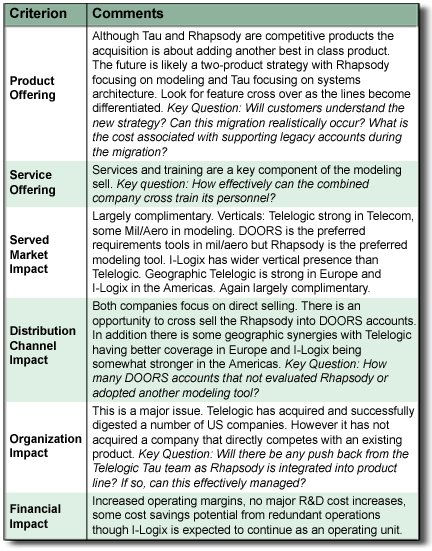
WIND Earnings today at 5pm
WIND's share price has been trending in February. Is this a sign of things to come? Not so fast. If you have the time, check in with the price at about 2pm or so (maybe 3pm). There is usually some movement around then...and that movement usually tells us the way things are going.
Tuesday, March 07, 2006
VDC's View Telelogic - I-Logix
The acquisition of I-Logix represents a continuation of Telelogic’s strategy to acquire leading companies in their respective corners of the application lifecycle management business. These acquisitions include:
Popkin (2005) - leader in enterprise architecture modeling (cost: $45 million)
QSS (2000) leader in requirements management tools (cost: $115 million)
Continuus (2000) leader in change and configuration management tools (cost: $42 million)
Other acquisitions include Verilog (SDL), COOL:Jex from Sterling Software (UML), Focal Point (decision management tool), Devisor (consulting) and Certeam (consulting)
Key observations:
I-Logix Rhapsody is likely the best-in-class software modeling tool. The acquisition brings another best-in-class tool into the Telelogic line continuing its successful acquisition strategy.
Telelogic’s transition from SDL to UML modeling has not been an easy one. While Telelogic has enjoyed great success in telecom, its move into other vertical markets has not been as successful. The acquisition brings instant credibility to Telelogic in the automotive, military and aerospace, medical and consumer electronics verticals.
The acquisition establishes the best-positioned modeling company in the embedded business from safety-critical, real-time applications to large systems architecture. The combination of Telelogic, I-Logix and Popkin is the “perfect storm” of software and systems modeling.
The acquisition brings together Telelogic’s strength in building product portfolios with I-Logix’s award winning product strategy. The key component that has been missing for Telelogic in its modeling products for some time.
This acquisition does not sacrifice the innovative relationship that I-Logix has established with Green Hills, which features a tightly integrated IDE/modeling environment.
I-Logix is also working on a partnership with Esterel Technologies to integrate Esterel SCADE certified code generator into Rhapsody. The result for military and aerospace customers could be a near-seamless experience from DOORS to Rhapsody to SCADE Qualified Code Generator (KCG) to Green Hills MULTI (certified by Esterel’s compiler certification tool), all running atop Green Hills’ INTEGRITY OS. Additional support comes from Enterprise Architect and SynergyCM. In addition to the end-to-end nature of the tool chain and the efficiencies of modeling, the benefits of this approach include compiler optimizations for faster, smaller code that is in essence certified by virtue of being generated by the certified code generator. VDC expects that other vertical markets will find this configuration appealing as well.
Bottom line: This is an important acquisition that benefits customers in a meaningful way while at the same time changing the competitive landscape of the industry. This is now clearly a 2-company market and Telelogic has the momentum.
Monday, March 06, 2006
Telelogic acquires I-Logix
What Happened:
Telelogic acquired I-Logix for $80 million in cash. The I-Logix team will form the basis of a new Systems and Software Modeling Division at the company. The new division will manage the Rhapsody, Statemate, Tau and Tau G2 products. I-Logix had sales of $26.8 million in 2005 and pre tax profit of $2.9million.
Embedded World Numbers are in
The participant numbers for Embedded World are in:
Exhibitors: 492
Attendees: 12, 234 (up 22%)
Speakers/Participants: 913 (up 22%)
Awards:
Software: QNX for QNX Multicore
Tools: pls Programmierbare Logik&Systeme for Universal Debug Engine
Hardware: NEC
VDC View: Embedded World continues to grow and maintain its place as the largest embedded trade show, but ESC West remains the most important. Could this change? Sure. But moving to San Jose is likely to boost ESC and help it maintain its importance.
Catch Us at ESC West
Chris and Matt will be at the show. If you would like to schedule time please drop us a line at the office. Email is best. Believe it or not, slots have already started to fill.
The Blog is Back!
On Target: Embedded Systems went to Maui for a couple of weeks and efforts to post from the island or from VDC Global HQ in Natick, MA were lacking. But we are back now. Tanned, Rested, Ready.
Wednesday, February 15, 2006
Access/Palmsource Announce New Linux Platform
At the 3GSM World Congress this week, Access and Access-owned PalmSource announced the availablility of the ACCESS Linux Platform (ALP).
The Rumors Were True: Oracle Moves To Acquire Sleepycat
Yesterday, Oracle definitively announced that it would acquire embedded database vendor SleepyCat Software.
Tuesday, February 14, 2006
Green Hills and Esterel
Green Hills Software and Esterel Technologies are announcing a partnership that will lead to a highly integrated package of products for DO-178B Level A and IEC 61508 SIL 3 applications.
The partnership appears to be modeled on an earlier Green Hills agreement with I-Logix. Indeed I-Logix and Esterel also share are partnership and integrations.
While it is difficult to tell at this point if the partnership is as deep as the I-Logix arrangement. If it is, this could be major step forward for Green Hills in the battle for the military/aerospace market. Green Hills appears to have seen the value in modeling and also in the Esterel certified code generator (KCG). The SCADE KCG produces code that is correct by construction. KCG produced code can avoid the MCDC testing required in DO-178B certification.
This agreement is indicative of Green Hills’ current partnering strategy. Find companies on similar fast growth trajectories that have similar cultures and goals, are market technical leaders and are willing to forge deep connections between products and perhaps organizations.
Other news from Embedded World:
Quadros Systems has ported their convergent RTOS technology to the Freescale ColdFire MCF532x and MCF537x processors. Because Quadros RTXC dual-mode RTOS offers optimized dataflow and control capabilities, it is able to maximize the DSP, RISC and I/O capabilities of these new platforms.
Aonix is announcing SWT graphics extensions for its PERC virtual machine. SWT, a Java-based graphics library and widget toolkit developed as part of the Eclipse platform, is designed to be as close to the native platform as possible, making it ideal for embedded applications. This integration makes Aonix PERC VM increasingly suitable for applications such as avionics, communications, industrial automation, office automation, power plants, transportation, mil/aero, and fleet telematics.
Express Logic, Inc. today announced that Express Logic’s ThreadX RTOS now supports the ARM CortexTM-M3 microprocessor. Also, Express Logic and Interpeak announced that the companies have integrated Express Logic’s ThreadX RTOS and Interpeak’s TCP/IP stacks.
QNX Software Systems announced a new operating system extension that allows developers to build hardened, secure compartments around their software applications while providing the flexibility to maximize CPU resources.
QNX Wins Award at Embedded World
QNX Software Systems today announced it was named a winner of the prestigious Embedded Award 2006 at the Embedded World conference. A panel of judges selected the QNX® Neutrino® Multi-Core Technology Development Kit (TDK) as the best product in the software category for its outstanding technical innovation in embedded technology. This is the second time QNX Software Systems has won the Embedded Award. In 2004, the company was recognized for the groundbreaking architecture of its power management framework.
Monday, February 13, 2006
Oracle to buy Sleepycat?
In this weekend's Wall Street Journal there are rumors of Oracle buying a number of companies including JBoss, Zend and Sleepycat. Sleepycat is the commercial supplier of BerkeleyDB - an open source embedded database.
Friday, February 10, 2006
Esmertec Moves Beyond the Client
Esmertec (SWX: ESMN) has acquired a company that will help it address the entire mobile phone value chain with enhanced capabilities targeting carriers. The acquisition of Cellicium will provide the basis for the company's Mobile Operator Division.
We just got off the phone with a major equity analyst who wanted to talk about the Linux and Java businesses. Then we saw this release. From our perspective, the mobile Java business comes down to just a couple of companies with Esmertec being one of them. But client side Java can be tough business, companies in this market need to add value around the JVM either on the client or up and down the carrier value chain. It is not enough to just deliver a JVM. With this move Esmertec is working on the later.
Highlights from the release:
Cellicium, founded in February 2001, operates in Bagneux outside of Paris and is a premier provider of mobile browsing solutions, applications and related services to mobile operators. In the new division, Cellicium will continue delivering these carrier-grade solutions and services to GSM operators.
Jean-Claude Martinez, President and COO of Esmertec, has been appointed to take on the additional responsibility as President of this division, effective immediately.
Esmertec has taken a 100% equity stake in Cellicium. The initial purchase price is approximately EUR12.5 Million in cash, with an additional estimated EUR9.5 Million conditional payout in 2006 and 2007. The payout is based on earn-outs, of which 70% will be in cash and 30% in Esmertec shares. Cellicium is a profitable and cash flow positive company.
Thursday, February 09, 2006
Microsoft Ups Its Indemnification Package
The full release is here.
Highlights:
The strengthened IP protection will be available worldwide to Microsoft’s mobile and embedded partners and will include the following:
•The defense of OEMs and distributors against IP claims in every country in which Microsoft distributes or markets its Windows Mobile and Windows Embedded products
•Protection of patent, copyright, trademark and trade secret claims based on Windows Mobile and Windows Embedded software
•Removal of the monetary cap related to defense costs
VDC's View:
IP protection is certainly an issue assessed by OEMs employing embedded Linux. Over 60% of the OEMs using embedded Linux surveyed by VDC perform an IP risk evaluation. However, any concerns about IP risk do not appear to be substantially slowing embedded Linux adoption. Whether it is the existing IP indemnification programs offered by Linux vendors and others or a general lack of concern over the risks, OEM adoption is so widespread that Linux consistently ranks as the leading embedded OS in VDC surveys.
This announcement signals an extension of Microsoft’s indemnification program and further mitigates the risk to OEMs of Microsoft introducing patented technology into its Windows Embedded Platforms. The lawsuit filled by Visto in December 2005 against Microsoft shows that disputes over patented technology can come from a number of directions in the mobile and embedded software market. Although Visto is not currently going after Microsoft OEM licensees, the fear is that at some point it might - much like what SCO is threatening for users of Linux.
The real danger here, in my opinion, is an injunction or other ruling preventing an OEM from deploying that software on its devices or creating uncertainty about future availability. NPT’s lawsuit against RIM has resulted in a number of industry watchers counseling about the risks of deploying RIM devices. Microsoft has addressed the injunction issue in its indemnification package, however its remedies will take time to engineer or negotiate. Of course, with shrinking product cycles being the norm in the embedded systems industry, time is the real enemy.
This announcement seeks to shift the balance in software platform selection in Microsoft’s favor by planting small seeds of doubt in the minds of developers and risk evaluators at OEMs. It is just one more way in which Microsoft has differentiated itself vs. open source/Linux. Is this a huge announcement? No. But it should be seen within the context of Microsoft’s other strategic efforts to set itself apart from the open source model.
Clearly Microsoft continues to see open source - and in particular Linux - as its most important embedded competitor. And it should.
Wednesday, February 08, 2006
VDC in BusinessWeek Article
FEBRUARY 6, 2006
Open Source's New Frontiers
By Sarah Lacy
MontaVista's Uncertain View
This startup, which embeds Linux in consumer electronics, is poised for big growth and maybe an IPO -- if Wind River doesn't spoil the party
Jim Ready, CEO of closely held software maker MontaVista Software, started off 2006 relaxed from a Hawaiian vacation and espousing an upbeat outlook. His company, which specializes in code that's "embedded" in consumer electronics and other gear, was entering its seventh year. And Ready was confident that in 2006 MontaVista would turn profitable and possibly move closer to an oft-rumored IPO. "When we started this company, we knew this would change the embedded computing world, and that has happened at a pretty good clip," Ready says.
Bold words for a man who's currently undergoing a search for his replacement, has recently accepted the resignation of his marketing chief, and is in the midst of a restructuring that calls for an undisclosed reduction in staff. None of that is uncommon in the rough-and-tumble world of emerging tech companies. But Sunnyvale, (Calif.)-based MontaVista has a reputation for results that don't quite live up to outsize goals. And as rival Wind River Systems (WIND ) begins treading on MontaVista's turf, pressure on Ready and his team to make good on promises has never been greater.
ANOTHER RED HAT? At stake: how big a slice of the $1.5 billion embedded-software market will end up with MontaVista, which has hitched its fortunes to Linux, the low-cost operating system that's updated by developers around the world via the Internet. Ready's model is Red Hat (RHAT ). Just as Red Hat sells and supports Linux for companies, MontaVista develops and supports a version of Linux that's sold to engineers working on a vast array of manufactured products, from phones and to telecom equipment to cars and other consumer devices.
It's not hard to see why MontaVista -- or any other budding open-source company -- would emulate Red Hat. Sales at Raleigh (N.C.)-based Red Hat jumped 44%, to $73.1 million, in its fiscal third quarter, which ended in December. Net income more than doubled, to $23.2 million, in the same period. But Red Hat is the exception -- not the rule -- among open-source players.
MontaVista wants to change that. The market for embedded software is poised to boom.
Currently, many would-be customers write their own code in-house. But that can be costly. And a growing number of manufacturers would rather rely on a standardized operating system, freeing engineers to focus on the concepts that can really distinguish a product, such as design and layout. MontaVista and Alameda (Calif.)-based Wind River both reckon the embedded market could become as big as $5 billion a year over time.
BIG OPPORTUNITY. And Linux has obvious benefits. For one, it's often cheaper than proprietary alternatives. Also, manufacturers don't want to be locked into an operating system over which they have little control. Nor do they want to be beholden to any one vendor, as many computers makers are with Microsoft (MSFT ) and its Windows operating system.
Little wonder that Linux is finding its way into more devices. Motorola (MOT ), Samsung, and Panasonic have all introduced Linux smart phones (see BW Online, 11/8/05, "Linux Answers Phone Makers' Call"). The Open Source Development Labs has embarked on several projects to standardize Linux for wireless handsets and telecom gear.
It has the makings of a big opportunity. When Ready was getting started in 1999, using Linux for devices was a radical idea. John Shoch of Alloy Ventures remembers getting the call in 1999 when Ready first proposed an embedded Linux company. It hadn't even occurred to Shoch, though he had made several investments in embedded software.
"I wish I'd thought of putting those two words together," Shoch says of "embedded" and "Linux." "On the spot we shook hands [on an investment deal]. We didn't know how to sell or execute or meet the needs but knew this was a whole new opportunity and we were going to figure it out."
"TRUE COMPETITOR." And figure it out they did. MontaVista, with soaring growth rates, outmaneuvered several small competitors in the early part of the decade. But that growth has tailed off in recent years, analysts say. The private company doesn't disclose revenue figures. But analysts say sales are in the range of about $30 million to $40 million a year. Ready says growth was about 20% last year.
That wouldn't be bad -- if MontaVista were a $1 billion software company. But for an up-and-comer, it's a red flag, says analyst Chris Lanfear of research firm VDC, who questions whether the growth rate is even that high. "It's certainly not a good indicator of market acceptance of what they're offering," says Lanfear. "I wouldn't discount the entrance of Wind River. MontaVista has never really had a legitimate, true competitor."
MontaVista's story is part cautionary tale for other emerging open-source companies that face an equally long, tough slog to profitability and high growth. The only pure-Linux success story is Red Hat, which took more than a decade to prove itself. Sweden's MySQL, which specializes in open-source databases, has upended that market, with nearly half of all Web sites running on its products. But MySQL's sales are just $40 million -- negligible compared to the $15 billion database market dominated by the likes of Oracle (ORCL ) and Microsoft.
"ARE YOU READY?" MontaVista, too, has had a tough time persuading clients to give Linux a chance. "Folks don't jump willy-nilly into this," Ready says. "How long does it take an elephant to have a baby? It's a long time, but you get this giant thing in the end."
Ready and his investors insist MontaVista is moving according to plan, despite burning through much, if not all, of the $75 million raised from investors and still not posting a profit. They say they have 2,000 customers and note that all of the Linux smart phones on the market use MontaVista Linux. Indeed, that market should grow nicely in the next few years as some handset makers, like Motorola (MOT ), look to shift more of their phones to a standard operating system like Linux.
Ready & Co. also insist that the restructuring and changes in upper management are aimed at getting MontaVista to profitability faster and bringing in new blood that has experience taking a company public. "Bankers are calling me regularly and saying, 'Hey John, we know MontaVista is the next pure-play Linux offer. Are you ready?'" Shoch says.
MAJOR IMPACT. Wall Street very well may be hungry for another public company that can benefit from rising demand for Linux. Red Hat's stock more than doubled in 2005 as it became apparent the company had finally hit on a winning business model. But Red Hat has had to earn that kind of appreciation. It's now growing at a much faster clip and it's scoring bigger deals. Most important, Red Hat doesn't have the competitive landscape MontaVista does.
After years of pooh-poohing Linux, Wind River did an about-face two years ago and now sells Linux tools and support alongside its own home-grown software. The impact in the embedded-device world is akin to Microsoft offering a Linux version of Windows. Wind River generated $235 million in sales in fiscal 2005, which ended in April, and it's already in all of the major accounts that MontaVista has spent six years scrapping for.
Though it's a latecomer to the Linux party, Wind River says it's making up for lost time. "The first mover has to find the way and sometimes learns through a series of mistakes," says Wind River Chief Marketing Officer John Bruggeman. "Sometimes they are not recoverable. [That] was very clear to us when we stepped back and asked the customer, 'Why are you pressing us to enter the Linux market so aggressively?'"
NAME-BRAND CHIEF. And while MontaVista has more Linux clients now, the device business is uncertain. Companies like Motorola could easily switch to Wind River for future phones if they were offered more favorable pricing or just felt more comfortable with a large public company.
Right now, many big handset makers are hedging their bets, using some Linux from each, analysts and customers say. A new CEO at MontaVista could make all of the difference. By his own admission Ready is a founder and an entrepreneur at heart. Running a larger company day-to-day isn't his forte or passion. If MontaVista could get a name-brand chief with public-company experience, it could instill confidence in customers, and get MontaVista over its current hump, into the black, and on the way to $100 million in annual revenues, before Wind River gains too much more ground. MontaVista also has yet to replace Kelly Herrel, the vice-president for marketing who departed in early January.
MontaVista is named for its first location, Monta Vista, an unincorporated area of Silicon Valley that was misspelled a century ago by land developers who meant to evoke the Spanish words for "mountain view." The outlook for MontaVista may be rosy for now, but it could swiftly darken if the Wind River onslaught gathers steam. That could relegate MontaVista to the ranks of Silicon Valley companies that pioneered a market only to watch a rival reap the rewards.
Subscribe to:
Posts (Atom)

