According to a note on the Embedded.com website, a new edittor will be replacing Jim Turley as he looks to devote more time to his consulting business.
Friday, August 11, 2006

New Eclipse White Paper Available at Eg3.com
Eg3.com recenlty released a whitepaper conducted in collaboration with VDC focused on the Eclipse tools market. If you have an interest in the developments in this market, there are some interesting research findings here that you will likely want to see.
Visit http://www.eg3.com/visible to get your copy. Look for future whitepapers VDC conducts in collaboration with Eg3 and other technology publications.
Wednesday, August 02, 2006
VDC's review of the 2006 Design Automation Conference
Click here to see VDC's review of the 2006 Design Automation Conference
Friday, July 28, 2006
Device Software Optimization – Does the Message Resonate with Developers?
Device Software Optimization (DSO) is a term coined and championed by Wind River Systems. DSO is the result of evolving vendor market strategies to meet the ever-changing technology landscape and the needs of developers. It represents a way to communicate their recognition of the complexity of device software development through the availability of broader sets of commercial-off-the-shelf software platforms.
Vendors have spent a significant amount of time and resources in defining and executing on their DSO strategy. Therefore VDC was interested in understanding in year two of DSO the depth and breath to which the message has connected with embedded software manufacturers.
Recently published research by Venture Development Corporation (VDC) indicates that slightly more than 41% of embedded developer survey respondents have at least heard of the term “Device Software Optimization.” However, of these, only about 12% believe they understand the underlying message.
According to Steve Balacco, Senior Analyst of VDC’s Embedded Software Practice, “In year two of DSO we find a mixed understanding for the DSO message within embedded system manufacturers (ESMs). Adding to the confusion by the developer community may be that vendors seem to have slightly different takes on just what is meant by their use of the acronym ‘DSO’ as a means to communicate strategic product and service offerings.”
DSO seeks a comprehensive approach to maximize the benefits and mitigate the downside of various trends within the development process. The compelling message is to empower developers through optimized, integrated solutions or platforms to enable product innovation, accelerate development, manage costs, and minimize risk. As such, vendors become strategic and trusted suppliers of end-to-end solutions.
According to Balacco, “Perhaps this idea of DSO as its own market provides the most confusion for developers and market participants. It may be that changing the mind-sets within these organizations will prove more difficult to achieve than expected and/or that impact has not been sufficiently quantified with respect to ROI and total cost of development.”
From VDC’s perspective, vendors need to inwardly examine their strategies and refine and focus the message so that ESMs can relate to and evaluate the benefits of investing in integrated commercial off-the-shelf software platforms.
Tuesday, June 13, 2006
Green Hills Responds to Express Logic Injunction: "It's okay to completely copy somebody else's interface"
After reviewing the copyright claim issued by Express Logic yesterday, Green Hills called the the allegations that Green Hills had illegally copied the ThreadX API ridiculous. In fact, Green Hills said that it would be allowed to exactly copy the application interface if it wanted as "It's been done many times by everyone in this industry, including Express Logic."
As VDC is not a legal body, we will reserve judgement until the matter has been decided by the arbitrators.
Monday, June 12, 2006
"µ used our APIs!" - Express Logic seeks injunction against Green Hills Software
Today, Express Logic announced that it would would seek to stop Green Hills Software from marketing its small footprint µ-velOSity operating system released in April of this year. Express Logic cited the similarity in the API structure between the Green Hills product (as sourced from a Green Hills Software Evaluation CD) and Express Logic's ThreadX operating system and further contended that the API used in µ-velOSity is a departure from the API structure used in other OSs in the Green Hills family.
These accusations are interesting when considered in conjuction with claims made on the release of µ-velOSity -- with Green Hills explicitly noting that the µ-velOSity product featured "an upward compatible API with velOSity and INTEGRITY." In fact, the idea of being able to write to a common set of APIs as a company scaled its product seemed to be a point of focus upon the release.
In fairness, Green Hills has yet to respond comments regarding the allegations, and any judgement has yet to be decided (Express Logic is opting to settle this matter through arbitration in conjunction with its existing reseller agreement.)
It will be interesting to hear the other side of the story.
Tuesday, June 06, 2006
Toyota to build own operating system
Toyota announced last Thursday that it will be working with Nagoya University to design its own operating system, due for release in 2010, to handle both vehicle control and in-car systems.
Thursday, May 18, 2006
Virtual System Simulation Evolution: Virtio Acquired by Synopsis
On Tuesday, there was interesting news in the ESL space. EDA leader Synopsys announced that it would acquire virtual system simulation player Virtio in a deal valued at around "$15 million depending on 'earnout'" according to EE Times.
With EDA, ESL, and virtual system simulation (VSS) vendors reporting encouraging revenue growth of late, the growing complexity of hardware architectures and increasing role of software development, as well as moves from other industry leaders like CoWare to enable hardware and software design/validation through a common platform, the time appears to have arrived for more unified ESL/VSS solutions.
While both ESL and VSS solutions hold their own value as stand-alone products used in the hardware development and software development processes respectively, the prospect of being able to use a single platform to both evaluate hardware designs and virtually vet software prior to fabricating the physical hardware seems an attractive notion.
Of course the real value in this concept is only realized where companies can get hardware and software development teams to work in a more collaborative way -- something that would be a substantial change from the way that today's embedded products are brought to market. However, this seems to be changing, especially amoung companies on the bleeding edge in time-to-market sentive industries like consumer electronics and telecom.
If, in fact, more unified ESL/VSS development turns out to be the long-term direction of the market, the next logical questions are: how will the remaining standalone VSS leaders be impacted by this type of an evolution, and what steps will the leading EDA players, namely Cadence and Mentor, take next?
Friday, April 07, 2006
VDC's Review of the 2006 Embedded Systems Conference in San Jose
Click here to see VDC's review of the 2006 Embedded System Conference
Friday, March 10, 2006
Samsung Turns to FSMLabs for Linux
FSMLabs continues to add customers and win business for its real-time Linux products. Samsung Heavy Industries is using RT Linux Pro in its shipbuilding robots. Move over Roomba and Scooba the previous most high profile Linux Robots.
Timesys signs up Linux developers
Timesys reports that it has signed up 2,000 developers for its LinuxLink service. LinuxLink is a repository of the latest packages, development tools and other types of community support for Embedded Linux.
Could this signal an upsurge in the use of non-commercial distributions? Perhaps. But it maybe it just signals a change in how those existing developers acquire patches and tools.
Thursday, March 09, 2006
WIND Q4 - VDC's View
Despite the hit that Wind River has taken in the market (down 20% at 2pm), its Q4 and FY06 earnings have many positive components including:
- 1st Quarter over $70 million in 15 quarters going back to Q4 2002.
- Overall Growth of 13% and deferred revenue growth of 27%.
- $50 million in cash flow.
- Many big design wins, especially in military/aerospace.
So what did Wall Street investors not like about the numbers:
- The company missed the low end of its guidance of $72-74 million by turning in a $70.2 million Q4.
- Lower than expected Q1 guidance of $65-70 million or $0.34 to $0.39 per share less than analysts' $0.47.
Other factors to consider in evaluating the numbers:
The transition from paid up front product licensing to a subscription business model will not be always be smooth. In fact, there will be some jumps and some lags in it. This quarter was a jump. More of WIND’s business came in under the subscription model than was expected. Some OEMs in markets that typically prefer PUF, including military/aerospace and industrial automation opted for subscription. Has the inflection point been passed? Not by any stretch but OEMs appear to be considering alternatives to PUF growing numbers.
It appears that some bookings that were expected to be recognized because they would be under the paid up front licensing model were actually puchased under subscription models. Although this hurts WIND in terms of quarterly performance, this is better for the company in the long term. Subscription deals tend to:
1. Be larger deals
2. Lock in customers for the long term
3. Be renewed at higher rates than PUF
4. Include more products and services
5. Be standardization deals
Also mentioned were a number of deals that have yet to hit balance sheet that VDC believes to be quite large.
Bottom Line:
Certainly WIND missed its expected revenue number for the quarter, however there appears to be a number of mitigating factors including growth, cash flow, a movement to customers into subscription licensing which is better for WIND, and a number of deals that have yet to appear in the financial statements. WIND’s results are not simple to understand. They are neither all positive, nor all negative. There are no straight lines here, instead you need to look at all of the information. For VDC, the preponderance of that information is positive.
Wednesday, March 08, 2006
Wind River Post Healthy Gains But Misses High End of Guidance
Analysts had expected the company to earn $0.12 per share on revenues of $74.20 million for the quarter.
Full-Year Highlights:
Reported revenue increased 13% year-over-year to $266.3 million
Deferred revenue increased 27% year-over-year to end at $98.3 million
Non-GAAP earnings per share of $0.29 and GAAP earnings per share of $0.26
Non-GAAP cash flow from operations of approximately $51 million, excluding restructuring related payments of $1.8 million; GAAP cash flow from operations of approximately $49 million
Fourth Quarter Financial Highlights:
Reported revenue increased 11% year-over-year to $70.2 million
Deferred revenue increased 12% sequentially vs. Q3 FY06
Non-GAAP net income of $10.3 million and GAAP net income of $10.3 million
Non-GAAP earnings per share of $0.11 and GAAP earnings per share of $0.11
Non-GAAP cash flow from operations of approximately $16 million, excluding restructuring related payments of $579,000; GAAP cash flow from operations of approximately $15.5 million
(Full VDC Coverage Tomorrow)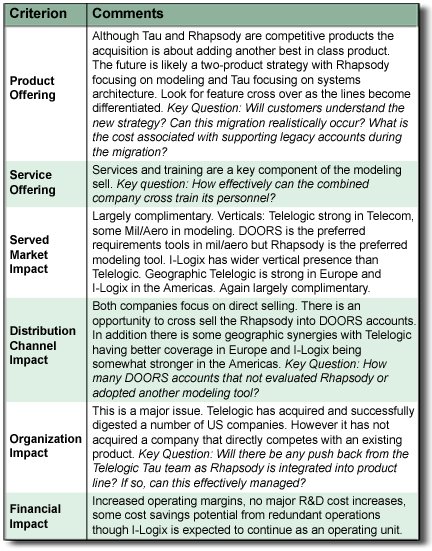
WIND Earnings today at 5pm
WIND's share price has been trending in February. Is this a sign of things to come? Not so fast. If you have the time, check in with the price at about 2pm or so (maybe 3pm). There is usually some movement around then...and that movement usually tells us the way things are going.
Tuesday, March 07, 2006
VDC's View Telelogic - I-Logix
The acquisition of I-Logix represents a continuation of Telelogic’s strategy to acquire leading companies in their respective corners of the application lifecycle management business. These acquisitions include:
Popkin (2005) - leader in enterprise architecture modeling (cost: $45 million)
QSS (2000) leader in requirements management tools (cost: $115 million)
Continuus (2000) leader in change and configuration management tools (cost: $42 million)
Other acquisitions include Verilog (SDL), COOL:Jex from Sterling Software (UML), Focal Point (decision management tool), Devisor (consulting) and Certeam (consulting)
Key observations:
I-Logix Rhapsody is likely the best-in-class software modeling tool. The acquisition brings another best-in-class tool into the Telelogic line continuing its successful acquisition strategy.
Telelogic’s transition from SDL to UML modeling has not been an easy one. While Telelogic has enjoyed great success in telecom, its move into other vertical markets has not been as successful. The acquisition brings instant credibility to Telelogic in the automotive, military and aerospace, medical and consumer electronics verticals.
The acquisition establishes the best-positioned modeling company in the embedded business from safety-critical, real-time applications to large systems architecture. The combination of Telelogic, I-Logix and Popkin is the “perfect storm” of software and systems modeling.
The acquisition brings together Telelogic’s strength in building product portfolios with I-Logix’s award winning product strategy. The key component that has been missing for Telelogic in its modeling products for some time.
This acquisition does not sacrifice the innovative relationship that I-Logix has established with Green Hills, which features a tightly integrated IDE/modeling environment.
I-Logix is also working on a partnership with Esterel Technologies to integrate Esterel SCADE certified code generator into Rhapsody. The result for military and aerospace customers could be a near-seamless experience from DOORS to Rhapsody to SCADE Qualified Code Generator (KCG) to Green Hills MULTI (certified by Esterel’s compiler certification tool), all running atop Green Hills’ INTEGRITY OS. Additional support comes from Enterprise Architect and SynergyCM. In addition to the end-to-end nature of the tool chain and the efficiencies of modeling, the benefits of this approach include compiler optimizations for faster, smaller code that is in essence certified by virtue of being generated by the certified code generator. VDC expects that other vertical markets will find this configuration appealing as well.
Bottom line: This is an important acquisition that benefits customers in a meaningful way while at the same time changing the competitive landscape of the industry. This is now clearly a 2-company market and Telelogic has the momentum.
Monday, March 06, 2006
Telelogic acquires I-Logix
What Happened:
Telelogic acquired I-Logix for $80 million in cash. The I-Logix team will form the basis of a new Systems and Software Modeling Division at the company. The new division will manage the Rhapsody, Statemate, Tau and Tau G2 products. I-Logix had sales of $26.8 million in 2005 and pre tax profit of $2.9million.
Embedded World Numbers are in
The participant numbers for Embedded World are in:
Exhibitors: 492
Attendees: 12, 234 (up 22%)
Speakers/Participants: 913 (up 22%)
Awards:
Software: QNX for QNX Multicore
Tools: pls Programmierbare Logik&Systeme for Universal Debug Engine
Hardware: NEC
VDC View: Embedded World continues to grow and maintain its place as the largest embedded trade show, but ESC West remains the most important. Could this change? Sure. But moving to San Jose is likely to boost ESC and help it maintain its importance.
Catch Us at ESC West
Chris and Matt will be at the show. If you would like to schedule time please drop us a line at the office. Email is best. Believe it or not, slots have already started to fill.
The Blog is Back!
On Target: Embedded Systems went to Maui for a couple of weeks and efforts to post from the island or from VDC Global HQ in Natick, MA were lacking. But we are back now. Tanned, Rested, Ready.
Subscribe to:
Posts (Atom)

