On Tuesday, there was interesting news in the ESL space. EDA leader Synopsys announced that it would acquire virtual system simulation player Virtio in a deal valued at around "$15 million depending on 'earnout'" according to EE Times.
With EDA, ESL, and virtual system simulation (VSS) vendors reporting encouraging revenue growth of late, the growing complexity of hardware architectures and increasing role of software development, as well as moves from other industry leaders like CoWare to enable hardware and software design/validation through a common platform, the time appears to have arrived for more unified ESL/VSS solutions.
While both ESL and VSS solutions hold their own value as stand-alone products used in the hardware development and software development processes respectively, the prospect of being able to use a single platform to both evaluate hardware designs and virtually vet software prior to fabricating the physical hardware seems an attractive notion.
Of course the real value in this concept is only realized where companies can get hardware and software development teams to work in a more collaborative way -- something that would be a substantial change from the way that today's embedded products are brought to market. However, this seems to be changing, especially amoung companies on the bleeding edge in time-to-market sentive industries like consumer electronics and telecom.
If, in fact, more unified ESL/VSS development turns out to be the long-term direction of the market, the next logical questions are: how will the remaining standalone VSS leaders be impacted by this type of an evolution, and what steps will the leading EDA players, namely Cadence and Mentor, take next?
Thursday, May 18, 2006
Virtual System Simulation Evolution: Virtio Acquired by Synopsis

Friday, April 07, 2006
VDC's Review of the 2006 Embedded Systems Conference in San Jose
Click here to see VDC's review of the 2006 Embedded System Conference
Friday, March 10, 2006
Samsung Turns to FSMLabs for Linux
FSMLabs continues to add customers and win business for its real-time Linux products. Samsung Heavy Industries is using RT Linux Pro in its shipbuilding robots. Move over Roomba and Scooba the previous most high profile Linux Robots.
Timesys signs up Linux developers
Timesys reports that it has signed up 2,000 developers for its LinuxLink service. LinuxLink is a repository of the latest packages, development tools and other types of community support for Embedded Linux.
Could this signal an upsurge in the use of non-commercial distributions? Perhaps. But it maybe it just signals a change in how those existing developers acquire patches and tools.
Thursday, March 09, 2006
WIND Q4 - VDC's View
Despite the hit that Wind River has taken in the market (down 20% at 2pm), its Q4 and FY06 earnings have many positive components including:
- 1st Quarter over $70 million in 15 quarters going back to Q4 2002.
- Overall Growth of 13% and deferred revenue growth of 27%.
- $50 million in cash flow.
- Many big design wins, especially in military/aerospace.
So what did Wall Street investors not like about the numbers:
- The company missed the low end of its guidance of $72-74 million by turning in a $70.2 million Q4.
- Lower than expected Q1 guidance of $65-70 million or $0.34 to $0.39 per share less than analysts' $0.47.
Other factors to consider in evaluating the numbers:
The transition from paid up front product licensing to a subscription business model will not be always be smooth. In fact, there will be some jumps and some lags in it. This quarter was a jump. More of WIND’s business came in under the subscription model than was expected. Some OEMs in markets that typically prefer PUF, including military/aerospace and industrial automation opted for subscription. Has the inflection point been passed? Not by any stretch but OEMs appear to be considering alternatives to PUF growing numbers.
It appears that some bookings that were expected to be recognized because they would be under the paid up front licensing model were actually puchased under subscription models. Although this hurts WIND in terms of quarterly performance, this is better for the company in the long term. Subscription deals tend to:
1. Be larger deals
2. Lock in customers for the long term
3. Be renewed at higher rates than PUF
4. Include more products and services
5. Be standardization deals
Also mentioned were a number of deals that have yet to hit balance sheet that VDC believes to be quite large.
Bottom Line:
Certainly WIND missed its expected revenue number for the quarter, however there appears to be a number of mitigating factors including growth, cash flow, a movement to customers into subscription licensing which is better for WIND, and a number of deals that have yet to appear in the financial statements. WIND’s results are not simple to understand. They are neither all positive, nor all negative. There are no straight lines here, instead you need to look at all of the information. For VDC, the preponderance of that information is positive.
Wednesday, March 08, 2006
Wind River Post Healthy Gains But Misses High End of Guidance
Analysts had expected the company to earn $0.12 per share on revenues of $74.20 million for the quarter.
Full-Year Highlights:
Reported revenue increased 13% year-over-year to $266.3 million
Deferred revenue increased 27% year-over-year to end at $98.3 million
Non-GAAP earnings per share of $0.29 and GAAP earnings per share of $0.26
Non-GAAP cash flow from operations of approximately $51 million, excluding restructuring related payments of $1.8 million; GAAP cash flow from operations of approximately $49 million
Fourth Quarter Financial Highlights:
Reported revenue increased 11% year-over-year to $70.2 million
Deferred revenue increased 12% sequentially vs. Q3 FY06
Non-GAAP net income of $10.3 million and GAAP net income of $10.3 million
Non-GAAP earnings per share of $0.11 and GAAP earnings per share of $0.11
Non-GAAP cash flow from operations of approximately $16 million, excluding restructuring related payments of $579,000; GAAP cash flow from operations of approximately $15.5 million
(Full VDC Coverage Tomorrow)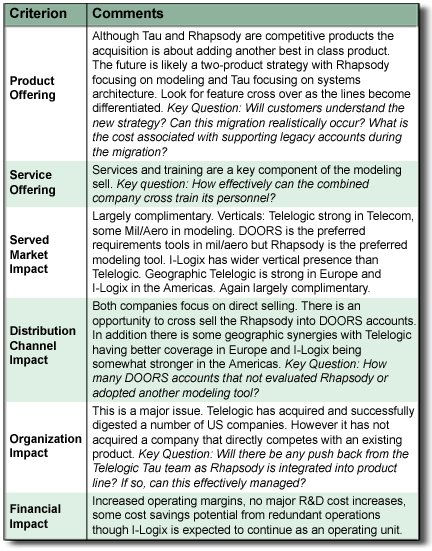
WIND Earnings today at 5pm
WIND's share price has been trending in February. Is this a sign of things to come? Not so fast. If you have the time, check in with the price at about 2pm or so (maybe 3pm). There is usually some movement around then...and that movement usually tells us the way things are going.
Tuesday, March 07, 2006
VDC's View Telelogic - I-Logix
The acquisition of I-Logix represents a continuation of Telelogic’s strategy to acquire leading companies in their respective corners of the application lifecycle management business. These acquisitions include:
Popkin (2005) - leader in enterprise architecture modeling (cost: $45 million)
QSS (2000) leader in requirements management tools (cost: $115 million)
Continuus (2000) leader in change and configuration management tools (cost: $42 million)
Other acquisitions include Verilog (SDL), COOL:Jex from Sterling Software (UML), Focal Point (decision management tool), Devisor (consulting) and Certeam (consulting)
Key observations:
I-Logix Rhapsody is likely the best-in-class software modeling tool. The acquisition brings another best-in-class tool into the Telelogic line continuing its successful acquisition strategy.
Telelogic’s transition from SDL to UML modeling has not been an easy one. While Telelogic has enjoyed great success in telecom, its move into other vertical markets has not been as successful. The acquisition brings instant credibility to Telelogic in the automotive, military and aerospace, medical and consumer electronics verticals.
The acquisition establishes the best-positioned modeling company in the embedded business from safety-critical, real-time applications to large systems architecture. The combination of Telelogic, I-Logix and Popkin is the “perfect storm” of software and systems modeling.
The acquisition brings together Telelogic’s strength in building product portfolios with I-Logix’s award winning product strategy. The key component that has been missing for Telelogic in its modeling products for some time.
This acquisition does not sacrifice the innovative relationship that I-Logix has established with Green Hills, which features a tightly integrated IDE/modeling environment.
I-Logix is also working on a partnership with Esterel Technologies to integrate Esterel SCADE certified code generator into Rhapsody. The result for military and aerospace customers could be a near-seamless experience from DOORS to Rhapsody to SCADE Qualified Code Generator (KCG) to Green Hills MULTI (certified by Esterel’s compiler certification tool), all running atop Green Hills’ INTEGRITY OS. Additional support comes from Enterprise Architect and SynergyCM. In addition to the end-to-end nature of the tool chain and the efficiencies of modeling, the benefits of this approach include compiler optimizations for faster, smaller code that is in essence certified by virtue of being generated by the certified code generator. VDC expects that other vertical markets will find this configuration appealing as well.
Bottom line: This is an important acquisition that benefits customers in a meaningful way while at the same time changing the competitive landscape of the industry. This is now clearly a 2-company market and Telelogic has the momentum.
Monday, March 06, 2006
Telelogic acquires I-Logix
What Happened:
Telelogic acquired I-Logix for $80 million in cash. The I-Logix team will form the basis of a new Systems and Software Modeling Division at the company. The new division will manage the Rhapsody, Statemate, Tau and Tau G2 products. I-Logix had sales of $26.8 million in 2005 and pre tax profit of $2.9million.
Embedded World Numbers are in
The participant numbers for Embedded World are in:
Exhibitors: 492
Attendees: 12, 234 (up 22%)
Speakers/Participants: 913 (up 22%)
Awards:
Software: QNX for QNX Multicore
Tools: pls Programmierbare Logik&Systeme for Universal Debug Engine
Hardware: NEC
VDC View: Embedded World continues to grow and maintain its place as the largest embedded trade show, but ESC West remains the most important. Could this change? Sure. But moving to San Jose is likely to boost ESC and help it maintain its importance.
Catch Us at ESC West
Chris and Matt will be at the show. If you would like to schedule time please drop us a line at the office. Email is best. Believe it or not, slots have already started to fill.
The Blog is Back!
On Target: Embedded Systems went to Maui for a couple of weeks and efforts to post from the island or from VDC Global HQ in Natick, MA were lacking. But we are back now. Tanned, Rested, Ready.
Wednesday, February 15, 2006
Access/Palmsource Announce New Linux Platform
At the 3GSM World Congress this week, Access and Access-owned PalmSource announced the availablility of the ACCESS Linux Platform (ALP).
The Rumors Were True: Oracle Moves To Acquire Sleepycat
Yesterday, Oracle definitively announced that it would acquire embedded database vendor SleepyCat Software.
Tuesday, February 14, 2006
Green Hills and Esterel
Green Hills Software and Esterel Technologies are announcing a partnership that will lead to a highly integrated package of products for DO-178B Level A and IEC 61508 SIL 3 applications.
The partnership appears to be modeled on an earlier Green Hills agreement with I-Logix. Indeed I-Logix and Esterel also share are partnership and integrations.
While it is difficult to tell at this point if the partnership is as deep as the I-Logix arrangement. If it is, this could be major step forward for Green Hills in the battle for the military/aerospace market. Green Hills appears to have seen the value in modeling and also in the Esterel certified code generator (KCG). The SCADE KCG produces code that is correct by construction. KCG produced code can avoid the MCDC testing required in DO-178B certification.
This agreement is indicative of Green Hills’ current partnering strategy. Find companies on similar fast growth trajectories that have similar cultures and goals, are market technical leaders and are willing to forge deep connections between products and perhaps organizations.
Other news from Embedded World:
Quadros Systems has ported their convergent RTOS technology to the Freescale ColdFire MCF532x and MCF537x processors. Because Quadros RTXC dual-mode RTOS offers optimized dataflow and control capabilities, it is able to maximize the DSP, RISC and I/O capabilities of these new platforms.
Aonix is announcing SWT graphics extensions for its PERC virtual machine. SWT, a Java-based graphics library and widget toolkit developed as part of the Eclipse platform, is designed to be as close to the native platform as possible, making it ideal for embedded applications. This integration makes Aonix PERC VM increasingly suitable for applications such as avionics, communications, industrial automation, office automation, power plants, transportation, mil/aero, and fleet telematics.
Express Logic, Inc. today announced that Express Logic’s ThreadX RTOS now supports the ARM CortexTM-M3 microprocessor. Also, Express Logic and Interpeak announced that the companies have integrated Express Logic’s ThreadX RTOS and Interpeak’s TCP/IP stacks.
QNX Software Systems announced a new operating system extension that allows developers to build hardened, secure compartments around their software applications while providing the flexibility to maximize CPU resources.
QNX Wins Award at Embedded World
QNX Software Systems today announced it was named a winner of the prestigious Embedded Award 2006 at the Embedded World conference. A panel of judges selected the QNX® Neutrino® Multi-Core Technology Development Kit (TDK) as the best product in the software category for its outstanding technical innovation in embedded technology. This is the second time QNX Software Systems has won the Embedded Award. In 2004, the company was recognized for the groundbreaking architecture of its power management framework.
Monday, February 13, 2006
Oracle to buy Sleepycat?
In this weekend's Wall Street Journal there are rumors of Oracle buying a number of companies including JBoss, Zend and Sleepycat. Sleepycat is the commercial supplier of BerkeleyDB - an open source embedded database.
Friday, February 10, 2006
Esmertec Moves Beyond the Client
Esmertec (SWX: ESMN) has acquired a company that will help it address the entire mobile phone value chain with enhanced capabilities targeting carriers. The acquisition of Cellicium will provide the basis for the company's Mobile Operator Division.
We just got off the phone with a major equity analyst who wanted to talk about the Linux and Java businesses. Then we saw this release. From our perspective, the mobile Java business comes down to just a couple of companies with Esmertec being one of them. But client side Java can be tough business, companies in this market need to add value around the JVM either on the client or up and down the carrier value chain. It is not enough to just deliver a JVM. With this move Esmertec is working on the later.
Highlights from the release:
Cellicium, founded in February 2001, operates in Bagneux outside of Paris and is a premier provider of mobile browsing solutions, applications and related services to mobile operators. In the new division, Cellicium will continue delivering these carrier-grade solutions and services to GSM operators.
Jean-Claude Martinez, President and COO of Esmertec, has been appointed to take on the additional responsibility as President of this division, effective immediately.
Esmertec has taken a 100% equity stake in Cellicium. The initial purchase price is approximately EUR12.5 Million in cash, with an additional estimated EUR9.5 Million conditional payout in 2006 and 2007. The payout is based on earn-outs, of which 70% will be in cash and 30% in Esmertec shares. Cellicium is a profitable and cash flow positive company.
Thursday, February 09, 2006
Microsoft Ups Its Indemnification Package
The full release is here.
Highlights:
The strengthened IP protection will be available worldwide to Microsoft’s mobile and embedded partners and will include the following:
•The defense of OEMs and distributors against IP claims in every country in which Microsoft distributes or markets its Windows Mobile and Windows Embedded products
•Protection of patent, copyright, trademark and trade secret claims based on Windows Mobile and Windows Embedded software
•Removal of the monetary cap related to defense costs
VDC's View:
IP protection is certainly an issue assessed by OEMs employing embedded Linux. Over 60% of the OEMs using embedded Linux surveyed by VDC perform an IP risk evaluation. However, any concerns about IP risk do not appear to be substantially slowing embedded Linux adoption. Whether it is the existing IP indemnification programs offered by Linux vendors and others or a general lack of concern over the risks, OEM adoption is so widespread that Linux consistently ranks as the leading embedded OS in VDC surveys.
This announcement signals an extension of Microsoft’s indemnification program and further mitigates the risk to OEMs of Microsoft introducing patented technology into its Windows Embedded Platforms. The lawsuit filled by Visto in December 2005 against Microsoft shows that disputes over patented technology can come from a number of directions in the mobile and embedded software market. Although Visto is not currently going after Microsoft OEM licensees, the fear is that at some point it might - much like what SCO is threatening for users of Linux.
The real danger here, in my opinion, is an injunction or other ruling preventing an OEM from deploying that software on its devices or creating uncertainty about future availability. NPT’s lawsuit against RIM has resulted in a number of industry watchers counseling about the risks of deploying RIM devices. Microsoft has addressed the injunction issue in its indemnification package, however its remedies will take time to engineer or negotiate. Of course, with shrinking product cycles being the norm in the embedded systems industry, time is the real enemy.
This announcement seeks to shift the balance in software platform selection in Microsoft’s favor by planting small seeds of doubt in the minds of developers and risk evaluators at OEMs. It is just one more way in which Microsoft has differentiated itself vs. open source/Linux. Is this a huge announcement? No. But it should be seen within the context of Microsoft’s other strategic efforts to set itself apart from the open source model.
Clearly Microsoft continues to see open source - and in particular Linux - as its most important embedded competitor. And it should.
Wednesday, February 08, 2006
VDC in BusinessWeek Article
FEBRUARY 6, 2006
Open Source's New Frontiers
By Sarah Lacy
MontaVista's Uncertain View
This startup, which embeds Linux in consumer electronics, is poised for big growth and maybe an IPO -- if Wind River doesn't spoil the party
Jim Ready, CEO of closely held software maker MontaVista Software, started off 2006 relaxed from a Hawaiian vacation and espousing an upbeat outlook. His company, which specializes in code that's "embedded" in consumer electronics and other gear, was entering its seventh year. And Ready was confident that in 2006 MontaVista would turn profitable and possibly move closer to an oft-rumored IPO. "When we started this company, we knew this would change the embedded computing world, and that has happened at a pretty good clip," Ready says.
Bold words for a man who's currently undergoing a search for his replacement, has recently accepted the resignation of his marketing chief, and is in the midst of a restructuring that calls for an undisclosed reduction in staff. None of that is uncommon in the rough-and-tumble world of emerging tech companies. But Sunnyvale, (Calif.)-based MontaVista has a reputation for results that don't quite live up to outsize goals. And as rival Wind River Systems (WIND ) begins treading on MontaVista's turf, pressure on Ready and his team to make good on promises has never been greater.
ANOTHER RED HAT? At stake: how big a slice of the $1.5 billion embedded-software market will end up with MontaVista, which has hitched its fortunes to Linux, the low-cost operating system that's updated by developers around the world via the Internet. Ready's model is Red Hat (RHAT ). Just as Red Hat sells and supports Linux for companies, MontaVista develops and supports a version of Linux that's sold to engineers working on a vast array of manufactured products, from phones and to telecom equipment to cars and other consumer devices.
It's not hard to see why MontaVista -- or any other budding open-source company -- would emulate Red Hat. Sales at Raleigh (N.C.)-based Red Hat jumped 44%, to $73.1 million, in its fiscal third quarter, which ended in December. Net income more than doubled, to $23.2 million, in the same period. But Red Hat is the exception -- not the rule -- among open-source players.
MontaVista wants to change that. The market for embedded software is poised to boom.
Currently, many would-be customers write their own code in-house. But that can be costly. And a growing number of manufacturers would rather rely on a standardized operating system, freeing engineers to focus on the concepts that can really distinguish a product, such as design and layout. MontaVista and Alameda (Calif.)-based Wind River both reckon the embedded market could become as big as $5 billion a year over time.
BIG OPPORTUNITY. And Linux has obvious benefits. For one, it's often cheaper than proprietary alternatives. Also, manufacturers don't want to be locked into an operating system over which they have little control. Nor do they want to be beholden to any one vendor, as many computers makers are with Microsoft (MSFT ) and its Windows operating system.
Little wonder that Linux is finding its way into more devices. Motorola (MOT ), Samsung, and Panasonic have all introduced Linux smart phones (see BW Online, 11/8/05, "Linux Answers Phone Makers' Call"). The Open Source Development Labs has embarked on several projects to standardize Linux for wireless handsets and telecom gear.
It has the makings of a big opportunity. When Ready was getting started in 1999, using Linux for devices was a radical idea. John Shoch of Alloy Ventures remembers getting the call in 1999 when Ready first proposed an embedded Linux company. It hadn't even occurred to Shoch, though he had made several investments in embedded software.
"I wish I'd thought of putting those two words together," Shoch says of "embedded" and "Linux." "On the spot we shook hands [on an investment deal]. We didn't know how to sell or execute or meet the needs but knew this was a whole new opportunity and we were going to figure it out."
"TRUE COMPETITOR." And figure it out they did. MontaVista, with soaring growth rates, outmaneuvered several small competitors in the early part of the decade. But that growth has tailed off in recent years, analysts say. The private company doesn't disclose revenue figures. But analysts say sales are in the range of about $30 million to $40 million a year. Ready says growth was about 20% last year.
That wouldn't be bad -- if MontaVista were a $1 billion software company. But for an up-and-comer, it's a red flag, says analyst Chris Lanfear of research firm VDC, who questions whether the growth rate is even that high. "It's certainly not a good indicator of market acceptance of what they're offering," says Lanfear. "I wouldn't discount the entrance of Wind River. MontaVista has never really had a legitimate, true competitor."
MontaVista's story is part cautionary tale for other emerging open-source companies that face an equally long, tough slog to profitability and high growth. The only pure-Linux success story is Red Hat, which took more than a decade to prove itself. Sweden's MySQL, which specializes in open-source databases, has upended that market, with nearly half of all Web sites running on its products. But MySQL's sales are just $40 million -- negligible compared to the $15 billion database market dominated by the likes of Oracle (ORCL ) and Microsoft.
"ARE YOU READY?" MontaVista, too, has had a tough time persuading clients to give Linux a chance. "Folks don't jump willy-nilly into this," Ready says. "How long does it take an elephant to have a baby? It's a long time, but you get this giant thing in the end."
Ready and his investors insist MontaVista is moving according to plan, despite burning through much, if not all, of the $75 million raised from investors and still not posting a profit. They say they have 2,000 customers and note that all of the Linux smart phones on the market use MontaVista Linux. Indeed, that market should grow nicely in the next few years as some handset makers, like Motorola (MOT ), look to shift more of their phones to a standard operating system like Linux.
Ready & Co. also insist that the restructuring and changes in upper management are aimed at getting MontaVista to profitability faster and bringing in new blood that has experience taking a company public. "Bankers are calling me regularly and saying, 'Hey John, we know MontaVista is the next pure-play Linux offer. Are you ready?'" Shoch says.
MAJOR IMPACT. Wall Street very well may be hungry for another public company that can benefit from rising demand for Linux. Red Hat's stock more than doubled in 2005 as it became apparent the company had finally hit on a winning business model. But Red Hat has had to earn that kind of appreciation. It's now growing at a much faster clip and it's scoring bigger deals. Most important, Red Hat doesn't have the competitive landscape MontaVista does.
After years of pooh-poohing Linux, Wind River did an about-face two years ago and now sells Linux tools and support alongside its own home-grown software. The impact in the embedded-device world is akin to Microsoft offering a Linux version of Windows. Wind River generated $235 million in sales in fiscal 2005, which ended in April, and it's already in all of the major accounts that MontaVista has spent six years scrapping for.
Though it's a latecomer to the Linux party, Wind River says it's making up for lost time. "The first mover has to find the way and sometimes learns through a series of mistakes," says Wind River Chief Marketing Officer John Bruggeman. "Sometimes they are not recoverable. [That] was very clear to us when we stepped back and asked the customer, 'Why are you pressing us to enter the Linux market so aggressively?'"
NAME-BRAND CHIEF. And while MontaVista has more Linux clients now, the device business is uncertain. Companies like Motorola could easily switch to Wind River for future phones if they were offered more favorable pricing or just felt more comfortable with a large public company.
Right now, many big handset makers are hedging their bets, using some Linux from each, analysts and customers say. A new CEO at MontaVista could make all of the difference. By his own admission Ready is a founder and an entrepreneur at heart. Running a larger company day-to-day isn't his forte or passion. If MontaVista could get a name-brand chief with public-company experience, it could instill confidence in customers, and get MontaVista over its current hump, into the black, and on the way to $100 million in annual revenues, before Wind River gains too much more ground. MontaVista also has yet to replace Kelly Herrel, the vice-president for marketing who departed in early January.
MontaVista is named for its first location, Monta Vista, an unincorporated area of Silicon Valley that was misspelled a century ago by land developers who meant to evoke the Spanish words for "mountain view." The outlook for MontaVista may be rosy for now, but it could swiftly darken if the Wind River onslaught gathers steam. That could relegate MontaVista to the ranks of Silicon Valley companies that pioneered a market only to watch a rival reap the rewards.
Tuesday, February 07, 2006
ENEA Full Year Highlights
From the Release:
VDC Note: Currency conversion (2005 average: 13.4 SEK to 1 USD)
Full Year
Net sales increased by 9 percent to SEK 712 (656) million. Adjusted for divested units, net sales increased by 20 percent.
Software sales increased by 17 percent to SEK 238 (203) million, accounting for 33 (31) percent of the Group's net sales.
Operating profit improved to SEK 56 (21) million, with operating margin rising to 8 (3) percent.
Profit after tax improved to SEK 69 (14) million. The deferred tax asset for the Group's Swedish units was capitalized, which had a positive effect of SEK 24 million on tax costs.
Earnings per share amounted to SEK 0.19 (0.04).
Fourth Quarter
Net sales amounted to SEK 194 (186) million.
Software sales increased by 1 percent to SEK 67 (66) million, accounting for 34 (36) percent of the net sales.
Operating profit amounted to SEK 17 (24) million, equivalent to an operating margin of 9 (13) percent.
Monday, February 06, 2006
PERC Pico Announced, Could 2006 be the Year of Real-Time Java?
Aonix appears to be working hard to fulfill VDC's real-time Java predictions (see our 5 Things to Watch in 2006 post) with the release of PERC Pico, its latest product.
Our notes on the release:
- PERC Pico is has smaller foot print and is faster than Aonix PERC, a full Java SE class VM
- PERC Pico does sacrifice some library support to achieve if size and performance capabilities
- Retains key Java advantages of code portability, modularity and reuse - as well as the large # of developers who know Java.
- Minimal footprint is about 128K
- C/C++ like performance can be achieved
- Latency is about 2-3 microseconds
- Utilizes t he RTSJ profile, but is not a full RTSJ implementation.
- Can be used with No RTOS (bare metal), with PERC for full Java SE support, or with an RTOS
Release:
Aonix®, the provider of the PERC® real-time virtual machine for embedded targets, has made available a pre-commercial “proof of concept” release of its new PERC Pico™ technology. PERC Pico is the first development environment for Java developers geared toward the creation of resource-constrained and deeply embedded hard real-time applications. PERC Pico is already being evaluated for use in a broad range of projects including: avionics, satellites, deep space probes, radio communications, weapons systems, and flight surface controls.
PERC Pico offers the advantages of Java™ development with footprint and execution performance comparable to C/C++ programs. PERC Pico makes it possible to create very small, fast programs with tight timing requirements using Java source code. The Eclipse-based PERC Pico environment combines off-the-shelf tools with standards-based annotations, a verifier, and automated build tools to create efficient executables and dynamically loadable class files. The built-in memory management removes the complexities and execution inefficiencies typically associated with conventional garbage-collection techniques that are not as suitable for resource-constrained applications.
“For years, the promise of a hard real-time solution for Java developers targeting deeply embedded or resource constrained applications has been mostly unfulfilled,” said Dave Wood, PERC Product Manager. “PERC has been the leading VM solution for complex, soft real-time applications for nearly a decade, and now PERC Pico will fill the void for the hard real-time needs typical in mission- and safety-critical applications.”
PERC Pico can be used in either a stand-alone configuration on bare target boards where footprint and execution speed are at a premium or in combination with the full PERC virtual machine in an RTOS environment. An RTOS-based configuration is ideal for complex embedded applications where developers need to combine high levels of functionality with access to low-level devices. The PERC virtual machine offers rich J2SE™-based capabilities and predictable garbage collection, while PERC Pico provides the low-level access and small latencies that are often required.
“Availability of the PERC Pico technologies is critical to fulfilling the Java Community Process requirement to establish a safety-critical Java standard”, noted Kelvin Nilsen, Aonix CTO. PERC Pico is designed as a profile of the RTSJ™ specification. Aonix, already active with the Open Group and the Java™ Community Process in working toward safety critical profile standardization, has volunteered to make this technology available as the basis for the official reference implementation.
PERC Pico is available now in limited pre-release form for qualified customers interested in evaluation of the technology. The commercial release of PERC Pico is scheduled for delivery in the second half of 2006.
Friday, February 03, 2006
LynuxWorks 2006 Vision Summit
 VDC attended the LynuxWorks “Vision Summit” in San Jose, CA this week along with a number of other analysts and press representatives in attendance. The session included a series of presentations that focused on the company’s positioning of their RTOS and tools products with a focus on satisfying open system, safety, and security requirements. In addition, the session served as an event to introduce new additions to the LynuxWorks Team, including Robert Day, Joe Wlad, and Steve Blackman.
VDC’s conclusions from the summit meeting:
LynuxWorks is one of the traditional RTOS companies in the embedded software market. They have long held a position within this market of supporting a dual approach for their operating system solutions – LynxOS and BlueCat Linux – offering a platform choice to OEMs.
From VDC’s perspective, this private company’s revenue has been stable over the last several years that have most likely contributed to the lack of investment in rebuilding the organization and marketing programs. The summit comes on the heels of a LynuxWorks press release in December 2005 that discussed the strength of their most recent quarterly results, optimism going forward, and additional financing from current investors. To be clear, the additional employees are seasoned veterans within the embedded software market. These additions demonstrate the company’s commitment to a more aggressive marketing and product campaign that focuses on their key strengths and differentiators for their products – adherence to open standards, consistent Eclipse-based software development tools, safety-critical/high reliability, and security/information assurance (for medium EAL 4+ and high EAL 6+), and software reuse/portability.
2005 has apparently been a very good year for the company. The selection by General Dynamics Advanced Information Systems group in April for the U.S Army’s Future Combat System (FCS) was a key win. There were most likely significant resources dedicated to making this win possible and countless more to ensure its continued success. While such a resource commitment might suggest a strategic shift in focus for the company in the short-term in key target industries, we expect that the company is betting on the increasing awareness across all industries to develop products more efficiently, with higher reliability, and software portability, while providing some level of information assurance.
Bottom line:
The company’s success in 2005 and optimism for the future has allowed them to invest in their marketing programs, organizational structure, and product R&D. All these together should position LynuxWorks to capitalize on their momentum going into 2006. What remains then is the hard part: executing against the strategy and realizing the returns on those investments.
Thursday, February 02, 2006
FSMLabs and the WIN-T Program
Battle of the IDEs
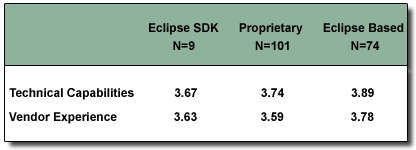 (Jan Liband from Encirq told me that I had not included the scale...Whoops, it was included in the original version...but not here. Sometimes you are too close to the data. Scale is 1-5, with 5 being the top score. Also, proprietary IDE is not ment to be a loaded term.)
Here is some data we collected last year, some of which was used in an Electronic Design article in January. As part of our surveying efforts, we ask developers to rate various IDE tool sets. In the survey these IDEs are listed by product name and vendor. In this case, we rolled up the specific IDEs into three categories.
1. Pure Eclipse SDK
2. Proprietary IDE (example: Tornado, etc.)
3. Eclipse-based IDE (example: Workbench, etc.)
The vendor experience rating may not translate well to downloading an SDK off the web but, of course, developers had no trouble in coming up with an opinion. We will take the data as it was reported, with some reservations about what it might mean.
What does the overall data mean? It appears that the developers we surveyed believe you can add value on top of an open source IDE and, that in some cases, those IDEs are superior to the traditional proprietary approach to IDE development.
Wednesday, February 01, 2006
News Round Up with Comments
Here are some of the more important news items of the last couple of days:
Green Hills Software, Inc., the leader in real-time operating systems (RTOS) and device software optimization (DSO), today announced the immediate availability of its entire DSO product line for Xilinx Virtex™-4 Platform FPGAs, including the INTEGRITY real-time operating system (RTOS), PowerPC compilers, TimeMachine debugger, MULTI integrated development environment (IDE), Green Hills probe, and SuperTrace probe. While each product is a leader in its space, together they form an optimized and highly integrated DSO solution that enables Virtex-4 system developers to create the highest performing and most reliable product in the least amount of time and at the lowest cost for solutions in the networking, medical, automotive, avionics, defense and industrial control markets.
VDC's View: Note the use of DSO in the beginning of this announcement. For those of you who thought this DSO thing was dead, guess again. None of the DSOers has given up yet. Wind, Enea and Green Hills look like they will stick with DSO for the foreseeable future. The subtitle of this release is: Immediate Availability of Leading Hardware and Software Solution for Software Defined Radio (SDR). The current JTRS programs are in some trouble with respect to being able to meet their technology and delivery promises. The future is, of course, SDR based but the current attempts at implementation may not be the ones that take us into that future.
Micriµm announces the release of µC/USB-MSD (V1.00)
The µC/USB-MSD stack enables you to use your embedded target device as a USB mass storage device. You can simply connect your product to a Windows-based PC.
VDC's View: MicroC OS? Why is that important? Because MicroC is everywhere even if you don't know it. Always good to keep an eye on what Micrium is up to.
Built on Eclipse, IBM Rational Systems Developer helps organizations trace industry-specific regulatory requirements from design to implementation. With its support for the Rational software portfolio, Rational Systems Developer enables engineers to manage their software development process more comprehensively and integrate compliance mandates into the process automatically.
For example, in the defense space, Rational Systems Developer helps systems engineers comply with mandatory defense systems requirements -- the Department of Defense Architecture Framework (DoDAF) -- by providing standardized views and reports on the system architecture. Rational Systems Developer is also able to create a visual model of a system's software design and can automatically generate code from the design, thereby saving time and increasing accuracy in future projects. Other compliance and standards initiatives primed to take advantage of Rational Systems Developer include AUTOSAR, DoD5000 and Navy Open Architecture certification and accreditation processes.
VDC's View: IBM's competitors have already staked a claim to the DoDAF market and indeed other industry specific frameworks as well. Telelogic acquired Popkin in 2005 and I-Logix released the award-winning Rhapsody 6.1 in 2005 as well. Cleary IBM needed to address these challenges. Although IBM is by far the leading vendor of modeling tools in the embedded market, questions still remain about the company's commitment and long term plans.
Friday, January 27, 2006
Concurrent Posts Loss - Bullish on SW Business
Concurrent has been emphasizing is software offerings recently:
- Reseller dealer withNovell to jointly sell and support Concurrent Real-Time Extensions Powered By SUSE Linux, a specialized Linux offering based on Novell's popular SUSE Linux operating system. (Jan 2006)
- Nighthawk development tools released to merchant market (Nov 2005)
- Several design wins for RedHawk RT Linux (2005/2006)
Additionally, we achieved higher overall gross margins partly due to our continued evolution to a software company. These operating results combined with the anticipated growth of both the video-on-demand business and our real-time operating system business indicate improving results in calendar 2006. Our enthusiasm is due to the huge growth in content availability for VOD, the success of near network DVR applications like "Start Over," and our recent announcement of a partnership with Novell to sell our real-time Linux operating system on the SUSE Linux release. Our real-time Linux operating system continues to gain momentum as the best high performance operating system in the market. We anticipate growing revenues in the coming quarters which, coupled with sound fundamentals, should tend toward positive results."
The financial info is below
ATLANTA, Georgia, January 27, 2006 - Concurrent (Nasdaq: CCUR), a worldwide leader of on-demand and real-time computing technology, today announced its results for the second quarter of fiscal year 2006.
In the second quarter of fiscal 2006, consolidated revenue for the company aggregated $18.9 million compared to $16.2 million in the first quarter of fiscal 2006, an increase of 16.3%. Revenue from Concurrent's on-demand product line totaled $9.8 million for the second quarter of fiscal 2006 compared to $7.3 million in the first quarter of fiscal 2006, an increase of 33.7%. Revenue from the company's real-time product line totaled $9.1 million for the second quarter of fiscal 2006 compared to $8.9 million in the first quarter of fiscal 2006, an increase of 2.1%. Cash at the end of the second quarter of fiscal 2006 totaled $17.0 million, a decrease of $0.4 million from the prior quarter.
The net loss for the second quarter of fiscal 2006 was $1.6 million, or a loss of $0.02 per fully diluted share, compared to a net loss of $2.2 million, or a loss of $0.03 per fully diluted share, in the first quarter of fiscal 2006.
FSMLabs adds ARINC Support
Does FSMLabs have the most complete Embedded Linux solution package for a company that is not a household/industry name? Wind River and MontaVista get most of the press (here too!), but FSMLabs continues to innovate and expand its offerings. The release has a full list.
We would not count on this product in safety critical apps. FSMLabs has had a great deal of success in test bench applications for the aerospace market. This appears to support those efforts.
FSMLabs has the product line, but lacks the market presence and awareness that other companies have invested in with venture-backed capital. We believe the company has largely bootstrapped itself over the years and while this conservative approach has a number of benefits, it is difficult to achieve the market presence of a MontaVista that way. That said, the problems that MontaVista appears to have are only compounded by investors with high-return expectations. Maybe the folks in Socorro have a better plan?
The release is here:
Socorro, NM - January 23, 2006 - FSMLabs, (http://www.fsmlabs.com) today announced ARINC 653 scheduling is now available in RTLinuxPro. Designed for avionics control and advanced hardware-in-loop simulation, ARINC 653 provides a fully protected and partitioned scheduling environment configured using a standard XML format. The ARINC scheduler has been added to FSMLabs' industry leading PSDD user space real-time product for executing real-time threads in the address space of Linux or BSD processes.
Richard Bond, who developed an RTLinuxPro based simulator in his work as Principal Real-Time Specialist for Lockheed-Martin, says:
"RTLinuxPro and PSDD enabled a simple simulation framework, allowed me the choice to develop user-level I/O drivers, and provided outstanding performance. ARINC 653 support will make this tool even more useful.”
PSDD is especially well suited to large scale simulation and test applications.
Dean Anneser, a Software Engineering Fellow at Pratt & Whitney says:
"PSDD provides a very cost effective scalable multiplatform solution (x86/ppc) for our simulation, control, and data acquisition systems.”
The ARINC 653 specification requires both time and space (memory) partitioning and also calls for XML scheduling configuration. FSMLabs has coupled these standard configuration, scheduling and protection mechanisms with RTCore's POSIX compliant OS interface. ARINC users get the benefits of specific scheduling windows, easy configuration, and application isolation, plus POSIX threads, semaphores, shared memory and other standard interfaces. The system supports, “C,” C++, and FORTRAN. ADA support is planned.
Modern off the shelf processors can perform at many times the capacity of previous generation special purpose systems so ARINC 653 “cabinets” can share processors or multiprocessors with standard PSDD and RTCore real-time threads and ordinary Linux processes. For example, databases and graphical visualization systems can run in left-over time.
RTCore's built-in SMP support is inherited by the ARINC 653 subsystem. Multiple ARINC “cabinets” can be run on a single system, reducing management overhead, cost, space, and power requirements. Where the computing requirements of the ARINC partitions is exceptionally high, RTLinux's processor control and reservation technology allows system architects the option of running only real-time code on selected processors.
The PSDD component already supported time and space partitioning, but FSMLabs has now added an option to PSDD for ARINC 653 required limitations on interaction between partitions. The FSMLabs implementation provides user-defined timing windows for specific partitions enabling users to create multi-threaded simulation compartments that are bound to specific periods of time within a cycle. Threads within a partition are dependent on their priority level within that compartment and are completely independent of other ARINC threads at any other priorities that may run during other time-slices.
FSMLabs'ARINC 653 support comes as an option to the RTLinuxPro development kit, which provides all of the tools needed to build hard real-time applications out of the box, including:
- A full set of compilers, libraries, and build tools, plus debugger
- The RTCore real-time server and a ruggedized embedded Linux kernel
- An Eclipse based IDE
- A small embedded target file system
- Carrier Grade Linux as an option
- Full FSMLabs state-of-the-art testing and quality assurance
Availability:
RTLinuxPro and ARINC 653 support are available immediately from FSMLabs and its worldwide channel partners. For a complete list of supported hardware, contact FSMLabs.
Cyclades(?) acquired by Avocent
What does a console and KVM acquisition story have to do with embedded software? Other than the products containing embedded software, not much it would seem. However, Cyclades was an early and outspoken supporter of embedded Linux. Cyclades was also an early MontaVista customer.
The company has even put a Penguin/Linux logo on its products.
Mentor Q4 Results - ATI Highlights
Mentor Graphics finished 2005 on high note, posting record revenue of $221.3 million for Q4.
During the corporate presentation the Embedded Systems Division (ATI) was mentioned twice:
- The operations in Mobile were disrupted by the hurricanes that hit the Gulf States.
- Embedded systems customer count more than tripled in Q4.
Not much here, but encouraging news for a strong industry close for 2005.
Thursday, January 26, 2006
Arrow, LynuxWorks, RTI, Motorola, Intel and Dot21 Partner on OA
This announcement came out yesterday from Arrow. Almost missed it.
Arrow Electronics Partners with Technology Suppliers to Deliver Open Architecture Solution to U.S. Armed Services
ENGLEWOOD, Colo.--(BUSINESS WIRE)----Arrow OEM Computing Solutions, the division of the North American Components (NAC) group of Arrow Electronics, Inc. ( ARW) that provides design engineering, manufacturing, system integration, supply chain management and post-manufacturing services to industrial OEMs and intellectual property-based companies, today announced it has partnered with Dot21, Intel, LynuxWorks, Motorola and RTI to deliver a new open architecture solution to the U.S. Armed Services.
The bundled hardware and software solution, called "OA Out of the Box," will offer the military and other government agencies a standard platform for developing open architecture-based solutions. This platform can serve as the foundation for any type of OA application and will enable designers to speed time to market and prevent them from having to conduct a complete re-design each time they begin a new development.
To create the solution, Intel and Motorola are contributing COTS-based (commercial off the shelf) open hardware components, such as computer blades, in a multitude of physical and mechanical configurations; RTI is providing the readily accepted middleware that enables different technologies to communicate; LynuxWorks is providing a POSIX-based open operating system; and Dot 21 is conducting performance testing. By relying on open architecture in systems such as the Navy's Ship Self Defense System and the Army's Future Combat Systems, the military is able to reduce costs, quickly deploy new solutions and facilitate the rapid exchange of information between soldiers, weapons, sensors and command platforms.
"As a distributor and integration partner, Arrow is in a unique position to bring together the offerings of its top suppliers to create comprehensive solutions such as 'OA Out of the Box,'" said Steve Ramsland, vice president and general manager, Arrow OEM Computing Solutions. "What's more, Arrow is bringing its logistics and integration expertise to the 'OA Out of the Box' solution, inventorying and ensuring the quality of each component and protecting against obsolescence by managing the supply chain."
Some good articles out this morning
There are a number of good articles about the challenges of innovation, technology and change in the papers today.
In the Financial Times there is an article on Kodak: "Kodak's focus on blueprint for the digital age" (You need to be subscriber or pick up a hardcopy)
Also in today's FT: "Brutal pace of innovation makes incumbents sweat"
FT also has a special section on India and Globalization.
In the Wall Street Journal on the front page is an article on Lockheed's struggles with its spy plane contract. Lockheed has seen the new face of military procurement and it is ugly. The article is: "Airborne Incident: As It Adapts to Information Age, Lockheed Fumbles Key Project"
Wednesday, January 25, 2006
Telelogic Q4 Results
Highlights (VDC comments in parentheses):
- Revenue $51 Million (converted using Q4 average exchange rate)
- Tau (UML tool) 18% of Revenues or $9.2 Million ($7.2M in Q4 2004)
- Tau G2 sales increased by 17%, G1 sales declined (to be expected)
- DOORS 44%, Synergy 23%
- System Architect 11% (acquired through Popkin acquisition cost $45M)
- Focal Point 4% (decision making application for product development)
- Earnings per share up 12%
VDC's View: This is a very solid quarter for Telelogic. We focus most of our efforts on Tau and the company's design automation tools, which are showing strength here - up $2M compared to Q4 2004. Most interesting in this announcement is the number of customers mentioned who are licensing multiple Telelogic products in multi-year agreements. Not only does this give a strong indication of future growth, but also shows the success of the company's acquisition strategy around DOORS and Synergy, although DOORS is the more successful product by far.
Sounds like DA Davidson Thinks WIND will hit its number
DA Davidson initiated coverage on Wind River today with a BUY. Remember Wind's fiscal year end is January. Seems like they have good feeling on this.
Say what you want about DSO but a number of analysts have initiated coverage on WIND in the past couple of months. Where were they when WIND was just in the "embedded" business?
Equity analysts who have started covering WIND since October 2005:
DA Davidson
AG Edwards
WR Hambrecht
Soleil
Citigroup
Prudential
New Senate Bill to support US Competitiveness
Some senators are taking notice and have sponsored a bill to address ongoing US competitiveness concerns. Could mean core technology research grants for vendors and researchers in the ESW world. Get in the line for the handouts.
The release is here. We will take a look at the legislation and report back.
VDC Smart Fabrics Research
Smart Fabric and Interactive Textile (SFIT): OEM and End-User Requirements, Preferences, and Solutions Analysis is VDC's second publication assessing the global SFIT market.
Report Highlights
The global market for electrically enabled SFIT technologies reached $304.0 million in 2005, and is expected to grow to $642.1 million by 2008, a compound annual growth rate (CAGR) of 28.3%.
According to OEMs, commercial prices were the largest inhibitors of SFIT growth. Some other barriers included: high costs of materials, slow funding/development, and poor OEM education and demand. Other comments included: the need to produce more effective washable form factors, and the need to educate end users of SFIT products and their functions.
At present the SFIT marketplace for electrically enabled applications only exhibits true competition in a few isolated instances where technical maturity has somewhat evolved.
Today the majority of the market rests in the automotive industry, however the electronics communication and entertainment devices segments hold the most competition. Reasons why this type of involvement has not spread to other industries include:
- Limited competition spread throughout different end-user markets.
- Required high levels of cooperation among SFIT supplier stakeholders to facilitate portfolios encompassing different industries and technologies.
Monday, January 23, 2006
RTI Offers Small Footprint NDDS Middleware
Although most of the success for the Data Distribution Service (DDS) middleware standard and RTI's NDDS product have been in the military/aerospace market it seems they are finding acceptance in a number of other markets as well, including industrial automation. The company has a number of customers in the IA market including:
Schneider Electric
Schilling Robotics
Max Planck Institute
Nikon
RTI was previously famous for its scope tools line which it sold to Wind River in order to focus on its NDDS middleware product.
From the release:
In an iterative and collaborative development effort with an industrial automation giant, the networkingexperts at Real-Time Innovations (RTI) have created a modified version ofRTI's NDDS real-time publish-subscribe communication middleware that can be used in low-cost, memory-constrained applications.
This new implementationof NDDS, which requires less than 100 kilobytes of memory, is currently deployed in a line of programmable logic controllers (PLCs). Because the standard version of NDDS can be used in high-end PLCs, developers can now deploy a common communication scheme across industrialcontrol networks that contains a full range of PLC cost and functionalityoptions
Standard RTI NDDS Developer Package is immediately available starting at$46,920 USD for a three-user perpetual license. Packages include NDDSmiddleware, NDDS tools and one year of support.
Friday, January 20, 2006
Stallman in eWeek
You can get a more serious look at GPL 3 from a number of sources including Linux Devices.
Here are some of the more enteraining parts of Richard Stallman in eWeek on GPL 3:
eWEEK Senior Editor Peter Galli: You said the main issues for you were making the license more easily compatible with other free licenses, as well as DRM (Digital Rights Management) and the whole patent issue. Tell me your thoughts on these issues.
Richard Stallman: DRM is an attempt to crush the freedom that copyright law gives the public. It is completely evil. DRM does not deserve to be tolerated and should be wiped out. It is tolerated because governments are not very democratic and the rich have too much power over governments and the media.
Another entry:
Galli: So, is the process now in the hands of the community?
Stallman: No. I will still be making decisions. The committees are going to take all the comments and boil them down to issues. Then they will start addressing the issues and looking at the various options. They will also try and decide how to deal with these issues, but ultimately I will be making those decisions. And, of course, if the community has found a good solution, they make that job easy.
One more:
Is Microsoft the greatest threat to freedom in software?
It is a mistake to think of the free software movement as an alternative to Microsoft. When we started this, Microsoft was not particularly important. In 1984, the system that people normally thought of as the system to compete with was Unix. That is why we have GNU's Not Unix: It couldn't be GNU's Not Windows because there was no Microsoft Windows then.
Microsoft is simply one example of a proprietary software developer, a software developer that tries to subjugate users to keep them divided and helpless. So what we are campaigning against, and trying to help people escape, is not any company in particular, but an antisocial system where software developers put restrictions on the users.
Worried about the state of US engineering?
Here is the session for at ESC San Jose:
Engineering Humanity Panel
Thursday, April 610:00am - 11:00am
Moderated by Brian Fuller, Editor-in-Chief, EE Times
It's under most Americans' radar, but technical education has become a silent crisis in America. The future of the nation's innovative culture is under stress as countries such as India and China graduate two to three times as many engineers. EE Times Editor-in-Chief Brian Fuller brings together a panel of educators and business leaders to frame the problem and offer solutions.
Seems like CMP editors are undecided about the situation. See Jim Turley's counterpoint here.
Bus and Boards Conference
VDC analyst Eric Gulliksen was out at the Bus & Board conference this week and has returned with a few pieces of information.
- Conference attendance seemed to be down a bit this year.
- The cell processor from IBM/Sony/Toshiba caused a stir. However vendors are unsure of the chips impact on the broad market. Mercury is offering what is calls the first rugged cell-based board product.
- RoHS compliance was a key theme. Not just on the conference schedule, but in vendor meetings as well.
- 2006 looks to be the year of RoHS compliance and vendors are concerned about the amount of effort that will be required...and more concerned about not complying.
- It is not just lead, but cadmium and other metals that are raising concerns. Cadmium, for instance, is used in the dye for some wire jacket insulation.
- One vendor commented that just changing a line SKU number can take as much as 30 man hours of work. That does not include the engineering or validation. Just the paperwork, updates to market materials and product documentation, etc. Some vendors have over 1 million SKUs.
- Bottom line: In 2006 the embedded boards vendors are going to be swamped with compliance activities. This could hurt innovation, new product development and other business activities.
More on RoHS from Wikepedia:
The Restriction of Hazardous Substances Directive (RoHS) 2002/95/EC was adopted in February 2003 by the European Union. The RoHS directive takes effect on July 1, 2006, but is not a law; it is simply a directive. This directive restricts the use of six hazardous materials in the manufacture of various types of electronic and electrical equipment. It is closely linked with the Waste Electrical and Electronic Equipment Directive (WEEE) 2002/96/EC which sets collection, recycling and recovery targets for electrical goods and is part of a legislative initiative to solve the problem of huge amounts of toxic e-waste.Each European Union member state will adopt its own enforcement and implementation policies using the directive as a guide. Therefore, there could be as many different versions of the law as there are states in the EU.
RoHS is often referred to as the "lead-free" directive, but it restricts the use of the following 6 substances:
PBB and PBDE are flame retardants used in some plastics.The maximum concentrations are 0.1% (except for Cadmium which is limited to 0.01%) by weight of homogeneous material. This means that the limits do not apply to the weight of the finished product, or even to a component, but to any single substance that could (theoretically) be separated mechanically — for example, the sheath on a cable or the tinning on a component lead.
As an example, a radio comprises a case, screws, washers, a circuit board, speakers etc. A circuit board comprises a bare PCB, ICs, resistors, switches etc. A switch comprises a case, a lever, a spring, contacts, pins etc. The contact might comprise a copper strip with a surface coating.Everything that can be identified as a different material must meet the limit.
So if it turns out that the switch's contact coating was gold with 2300 ppm cadmium then the entire radio would fail the requirements of the directive.
Encirq adds VP and GM
Encirq has added an executive to spearhead North American operations. The company hopes to mirror the success of a similar strategy that it implemented in Japan.
Some select information from the release is below:
ENCIRQ Corporation today announced the appointment of Dylan Kennedy as Vice President and General Manager, Americas. Kennedy will be responsible for building out field operations to help ENCIRQ’s customers accelerate the delivery of innovative new products.
He joins ENCIRQ from NextHop Technologies, where he was Vice President of North American Sales. He previously held senior management positions at a number of the industry’s leading software companies including Western Regional Sales Director for Wind River Systems (Nasdaq: WIND) and UK Country Manager for Integrated Systems, Inc.
Wednesday, January 18, 2006
Linux FUD from the BSD Camp
BSD supplier Wasabi Systems is offering a new take on Linux FUD (fear, uncertainty and doubt) this time it is Sarbanes-Oxley compliance.
The gist is this:
Effectively, executives are lying to their shareholders if they do not disclose, or do not know, that the company doesn’t have a valid license for software it is claiming as an
owned asset. Unlike a mere GPL violation, this misrepresentation is a crime, and carries
criminal penalties.
Wasabi's conclusions include the following:
The Sarbanes-Oxley Act radically changes the risk portfolio for companies using Linux as a
development platform. Violations of the Linux license, and even the common practice of
leaving GPL compliance to engineers, are, we believe, violations of federal law. Companies
thus face the choice of complying fully with the GPL (despite the loss of intelectual property
and the intrusiveness of legal review), risking federal sanction, or seeking alternatives to
embedded Linux (which may include proprietary systems, or open source products governed
by different licenses, such as the BSD license). Violating the GPL, for public companies and
those which seek to become public, is now a federal crime.
Wasabi has another White Paper out there on this topic and it has this interesting paragraph:
The real problem here is that the GPL was created by the Free Software Foundation with an
ideological, not a commercial, aim in mind. Is it any surprise that a proprietary software company runs into legal issues when it uses the license of the "Free Software Foundation"?
and this line as well,
Unless embedded Linux users are content to release all their code, they are wise to look for insurance.
Or use BSD perhaps?
We are not sure how much fire is here with this line of attack but the documents are worth a look.
Microsoft is Touting Real Time Capabilities of CE
We don't know if you have seen the add that Microsoft is running in recent issues of EE Times and perhaps other places, but it is worth a look. It features an R&D manager from Chaveriat Robotique and one of their robotic arms that runs CE. The quote from the R&D manager is "We chose Windows CE because it offers real-time and graphics at the right price."
In addition there is an article we saw yesterday on eetimes.com on real time and CE 4.2.
Also, a November 2005 article entitled "Windows CE 5.0 for real-time systems" appearing in Embedded Computing Design. The author was Mike Hall one of Microsoft's technical point people for Windows Embedded.
Interestingly, a quick google search on Win CE unrelated to this article produced a Microsoft ad on the side. The first keyword in the ad was "RTOS"
This might be trend to keep an eye on. It seems like the most activity directed at touting Windows CE real-time capabilities since the 3.0 release when the company was using supporting materials from Siemens.
Windows CE is in a wide variety of devices. Probably a more varied collection than most industry observers would give them credit for supporting. Many don't have the Windows logo, some are headless and some would even be the types of devices that traditional RTOS players would like to be in. Microsoft will be in increasing competition with the traditional OS players in key markets like automotive, consumer devices and industrial automation.
Tuesday, January 17, 2006
More new products Trolltech
We don't want this to be a collection of new product announcements but we will try and highlight some of the more important ones like this one from Trolltech.
Trolltech is a key enabler of Linux, especially in mobile phones. The company has a major presence in Asia, with China likely being its top market. No surprise really given the strength of Linux in the mobile handset market there.
This product update would typically support devices other than handsets, but demonstrates the product range from desktops to traditional embedded devices to mobile devices. Part of the release is inserted below:
Qtopia Core: Development Platform for Single-Application Products
Qtopia Core as a stand-alone technology is a robust, customizable development platform for creating single-application devices powered by embedded Linux. Designed for high value applications, it includes a comprehensive set of libraries and graphical tools to help organizations quickly and cost-effectively create embedded Linux-based products.
Qtopia Core supports the same APIs as Qt 4 – bringing the benefits of Trolltech’s proven desktop software to developers of a broad range of embedded Linux equipment. It includes all the latest Qt features such as extended support for heavy-duty graphics, more internationalization with right to left text, and better tools for highly productive development.
Qtopia Core customers will also reap the benefits of Qt’s worldwide developer community.
Trolltech plans to expand the Qtopia 4 Series in the coming months to address a broader range of embedded Linux opportunities. Anticipated products in the Series will include:
Qtopia Platform: Qtopia Core with application management and user interface capabilities, enabling embedded Linux development for consumer electronics and other advanced, multi-application products.
Qtopia Profiles: Qtopia Platform with key enablers for embedded Linux development aimed at specific vertical markets.
Qtopia Editions: Solutions aimed at targeted product segments.
The Qtopia Series today features Qtopia Core 4, Qtopia Phone Edition and Qtopia PDA Edition
New Products from GHS and MG/ATI
Two new products announced today:
Green Hills Software, Inc., today announced the immediate availability of a complete port of its INTEGRITY real-time operating system to the BAE Systems’ RAD750 radiation hardened PowerPC Processor and CompactPCI single board computer.
The RAD750 is a licensed radiation hardened version of the IBM PowerPC 750 and is the follow-on to BAE System’s RAD6000 family. The RAD750 architecture supports 260 MIPS operating at 132 MHz.
Accelerated Technology, a MentorGraphics division, today announced the availability of the Nucleus Cipher Accelerator software, a plug-in to the Nucleus Cipher Suite that adds support for hardware encryption acceleration. The software allows designers to boost the performance of their security applications, resulting in increased data throughput and lower processor utilization. The Nucleus Cipher Accelerator initially supports the Freescale Semiconductor ColdFire MCF5235, MCF5271, MCF5275, MCF547x, MCF548x and PowerPC MPC8272 processors.
More on US competitiveness
Two articles appeared over the last couple of days on US competitiveness. The first reports a speech by former Speaker of House Newt Gingrich and the second is Jim Turley throwing a cold bucket of water on the whole lack of engineers in the US argument. See the On Target: Embedded Systems posts from last month on this topic. I have included Newt’s recommendations below.
Like most of the recommendations from politicians it reminds me of the Monty Python sketch called "How to do it." Which goes something like this:
"But first, here's Jackie to tell you all how to rid the world of all known diseases."
"Well, first of all, become a doctor and discover a marvelous cure for something, so there'll never be any diseases ever again."
"Thanks, Jackie. Great idea."
Anyway there are recommendations from an embedded.com article, the first couple are even possible to implement:
- Create a system of civil justice to reduce the burden of lawsuits and give incentives to young people to go into professions other than the law.
- Dramatically simplify the tax code to favor savings, entrepreneurship, investment and constant modernization of equipment and technology.
- Make math and science learning equal to any in the world and educate enough young Americans in science to enable the United States to compete successfully with other well-educated societies.
- Invest in the potential scientific breakthroughs in energy, space and the environment.
- Create, via high tech, "a 21st century intelligent health system" that would improve the health of the populace while dramatically lowering health care costs and making American health care a value export and source of revenue.
These recommendations are applicable to any country thinking about is place in the World during the second half or so of this century.
Monday, January 16, 2006
Express Logic Signs Datang Mobile to License
This release came through the email box last week.
RTOS supplier Express Logic has signed Datang Mobile to a license for ThreadX. VDC believes that this is a Datang phone or reference design. In addition, the companies are also negotiating for Datang to bundle and distribute ThreadX with a mobile phone SoC. ThreadX will support the RF capabilities of the phone/chip.
While this is not Express Logic's first handset deal, it may be its most important. Datang has the potential to be a prime mover behind TD-SCDMA (Time Division - Synchronous Code Division Multiple Access), the Chinese developed 3G protocol, and having ThreadX bundled in could be an important win for the San Diego-based Express Logic.
RTOS support for RF communications on handsets has largely been based on in-house OSs with commercial vendors like, Mentor Graphic/ATI and ENEA also capturing a large part of the market.
ThreadX was probably appealing to Datang for its small footprint, reliability and royalty-free business model. For SoC vendors, not adding on high prices for bundled software or eating a portion of the software bill of material themselves makes their products more competitive and enhances the bottom line.
Thursday, January 12, 2006
Ousourcing Trends: Software Development
Outsourced manufacturing is the most common type of third party service used in the development/production of embedded devices. However, the use of third party services in the hardware and software development process isn't far behind.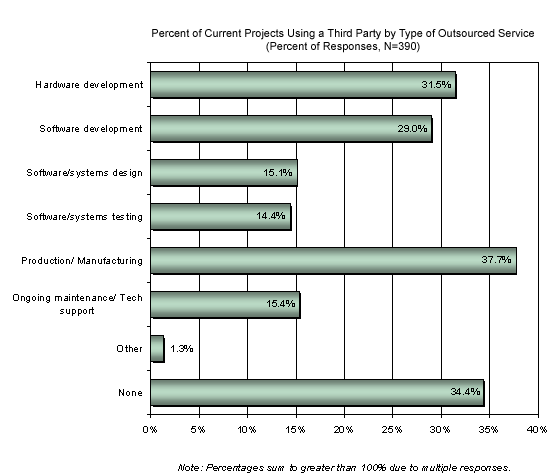 Research from VDC's recently published Market Statistics report indicates that in the case of outsourced manufacturing, the goal tends to be to reduce costs. However, with hardware and software development, it is more often the demand for additional development resources or the need for assistance in an area that is outside a development team's core competence that drives the demand for third party services.
Wednesday, January 11, 2006
High percentage of embedded projects still run behind schedule
The latest findings from VDC's 2005 Volume VIII: Embedded Systems Market Statistics report, show that nearly 40% of embedded development projects run behind schedule. In fact, over 80% of the projects running behind schedule are at least 2 months late.
While the percentage of late projects is substantial, it's an improvement from previous years in which VDC research has indicated that a majority of projects were running late. The medical, military/aerospace, and industrial automation industries had the highest percentage of late projects, while the retail automation and consumer electronics markets had fewer late projects on average.
Tuesday, January 10, 2006
VDC Proprietary Operating Systems Report Highlights
Some interesting information from VDC’s recently completed 2005 Embedded Software Strategic Market Intellegence Program - Volume VII: Proprietary Operating Systems:
VDC’s developer survey found that 37.1% of the respondents use a non-commercial OS as part of their device development. This represents an ongoing migration for this population of developers, from 43.1% in 2001. The development and use of non-commercial OSs is a result of an era when developers had a lot of restrictions that included expensive hardware and limited and expensive memory. Developers cite various reasons for the continued use of non-commercial OSs ranging from technical specifications to development and production costs. Considering these issues, some developers just do not see a compelling reason to adopt a commercial OS solution. It may be that the additional features offered by a commercial OS are just not required and don’t outweigh the additional resources (i.e., memory, etc.) that would need to be included or would exact performance penalties. In many cases, the needs of their application are extremely specific and the use of a non-commercial OS gives developers the ability to customize their environment to match their exact needs.
As customers demand smarter, more controllable devices, developers will look to increase software functionality. Adding new features to products increases the complexity of non-commercial OS software. Non-commercial OS users will look to switch to commercial OSs where this added functionality is available and allow developers to concentrate on their core competencies of developing discriminating features that will be attractive to the end user, rather than on software technologies that are transparent to the end user.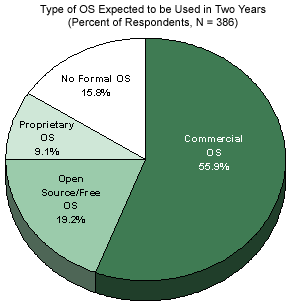 VDC expects the population of developers using a non-commercial OS – either proprietary or no formal OS – will decline in the future as networking, increasingly complex software, and advancing hardware will require commercial OSs. However, VDC expects the use of open source/free operating systems as a migration path to increase as technologies such as Linux mature and where there is already a growing interest by embedded software developers for its use.
Friday, January 06, 2006
For more information on the changes at MontaVista
LinuxDevices has done some additional reporting on the shake up at MontaVista (see our post below). Check it out here.
MontaVista Shake Up
There has been a shake up at MontaVista with some executive resignations in the mix.
The changes include Senior Vice President, Strategic Operations Kelly Herrell resigning.
A number of other managers are leaving the company as well, although the resignations are not thought to be related.
Thursday, January 05, 2006
VDC Market Stats Report Highlights
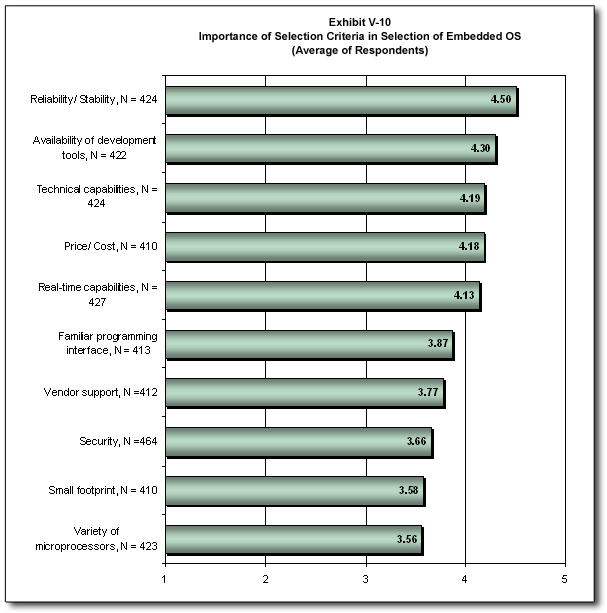
VDC's Market Statistics Report was published recently. Here is an interesting chart (one of many) in the report. The data is on scale of 1-5 with 1 being not important and 5 being very important.
What we find of note here is how far down on the list Price/cost is. Tools rank very high as they do in the processor purchasing decision. But the highest rated requirement is Reliability/stability.
Security is way down the list. Amazing with all the emphasis on secure systems. VDC is betting that security becomes a key feature in 2006.
Click here for more information on the report and the brochure.
WIND Up Today
WIND is up big today on the Nasdaq. This could signal the start of a run up before the company's fiscal year end and earnings announcement.
We pulled this from breifing.com for those of you who are into technical analysis:
12:22PM Wind River - - Relative Strength (WIND) 15.24 +0.56 : The stock displays RS as it stages a breakout above its 15.00/ 15.13 resistance area to a fresh 4-month high. Next area of interest lies near the upper end of its late-August bearish gap at 15.70.
Wednesday, January 04, 2006
The VCs See Something in Savaje
Mobile Java OS company Savaje raised another $40 million in December 2005. We thought we had seen this release before, so we did a bit of checking. Near as we can tell this is the Savaje funding history:
1999-2003 $12M
2003 $17.5M
2004 $40M
2005 $40M
Total $109.5 M
That is a lot of money for a product entering a maturing mobile OS market with lots of competition. The company is on version 2.5 of the OS and to date has not one deployed product. Good Sense PDA is expected to release the first handset shortly and LG has shown a Savaje powered phone.
My point here is not to stick it to Savaje. Just to point out that the VCs must see something here. Perhaps it is the potential for Savaje to be another Symbian. Remember how long it took that company to gain any momentum?
In 2004, the last year of data VDC has collected, Symbian did $114 million. In the first half of 2005 Symbian shipped more phones than in all of 2004. Also in the first half of last year the installed base of Symbian phones 39 million units. Of course, Symbian has Nokia.
Mapusoft OS Support
We get updates from Mapusoft on their products which automate the porting of application software to alternative OSs. Here are the current OSs supported. This might indicate demand for porting from various OSs and demand for porting to various OSs. Perhaps we are reading to much into the product support lists. But here they are:
Currently, OS Changer solutions are available for:
Porting from pSOS and VxWorks to: Nucleus PLUS, Precise/MQX, ThreadX, Linux, LynxOS, Solaris, eCOS, uITRON, Windows CE, and Windows Embedded XP.
Porting from Nucleus to: Linux, LynxOS, eCOS, Windows CE, Windows Embedded XP.
We also offer OS Changer solutions to port POSIX code to various target operating systems. Please contact us to find out supported POSIX APIs and target operating systems.
ATI
Accelerated Technology, the embedded software arm of Mentor Graphics (Nasdaq: MENT) had two announcements this morning. It is interesting to look at them together.
The first announces support for the PictBridge standard, from the Camera & Imaging Products Association (CIPA) - this provides technology that allows direct print capabilities from a digital camera to a printer.
The second is that Beatnik's mobileBAE software now supports the Nucleus PLUS RTOS.
ATI is extending its support for multimedia and mobile/handheld devices by further integrating third party standards and technology. ATI is a strong player in the consumer electronics field where its royalty free, small footprint RTOS fits well with the market requirements (high volume, tight margins).
ATI continues to build out its support for the various types of devices that we broadly call consumer electronics. VDC expects ATI to continue its strategy of adding value to its core RTOS product offering through the integration of third party technology thereby capturing some of the revenue that developers previously invested in doing the integration themselves.
Tuesday, January 03, 2006
5 Things we are Looking for in 2006
The Battle for the Soul of DSO
DSO hit the streets a couple of years ago. Wind River said that they only gave the concept a name, “Device Software Optimization,” and that the underlying principles were already in the marketplace. Several vendors have taken Wind River up on its offer to define a new market most-notably Green Hills and ENEA. Each of these vendors adopted a definition of DSO that best fit with their offering and industry positioning. There has been some backlash by Wind River -most importantly in CMO John Bruggeman’s blog where he has struck out at both GHS and ENEA. Our bet is that it shakes out in 2006 or vendors will get tired of the whole thing and leave DSO to Wind River.
Security
Everyone is concerned about security, but our surveys indicate that very few developers are actually using security protocols in their devices. This will change in 2006. Suppliers of embedded and real-time operating systems will provide greater and easier access to security components in their platform offerings and security vendors will be much more prominent in the marketplace.
RT Java (again)
This is like going back to the future. We think we have written this one before. But seriously it will happen this time. Well, it should happen this time, especially in the military market where much of the work is being done. Growth in this market will be driven by the US Military’s commitment to open architectures, and the evolving improvements in Java real-time support through both the Real Time Specification for Java (Java Community Process RTSJ) and subsets for providing real-time, safety-critical, and mission-critical support from suppliers in programs such as the Navy Open Architecture Computing Environment (NOACE), the Army’s Future Combat Systems, and the joint DARPA, Air Force, and Navy Joint Unmanned Combat Air Systems (J-UCAS).
Consolidation
VDC expects 2-3 major acquisitions in 2006. The operating system and broad line suppliers of embedded tools and components will be the targets.
The VDC Blog
In 2006 VDC’s Web log will be the first real-time news and analysis source for the industry. It will be the best way to spend the first couple of minutes of your day.
Is Linux a Cult?
I was catching up on my DVR viewing over the long weekend and caught an episode of Frontline on PBS called “The Persuaders.” In it, the CEO of Saatchi and Saatchi talks about certain brands that are "lovemarks" - a brand for which the consumer has "loyalty beyond reason." He likens these to cults and in trying to understand consumer behavior around these brands undertakes a study of cults including in one scene: Linux Users.
Although that is a funny aside...this program should be viewed by anyone who is responsible for convincing others to buy products.

